How Acoustic Quieting Technology in Submarines Work
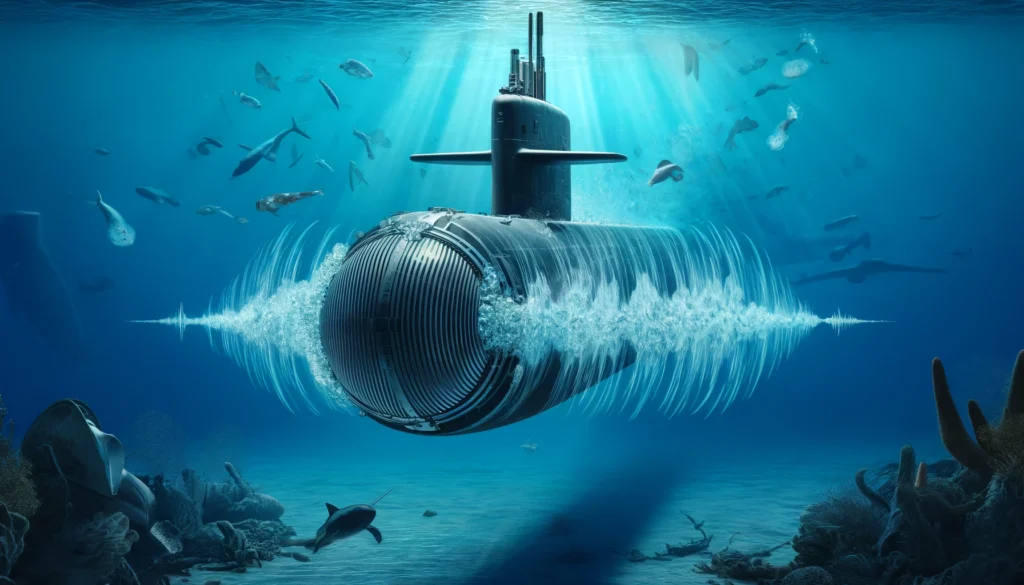
A submarine’s acoustic quieting technology works by intercepting, absorbing, or eliminating sound before it can leave the vessel. Naval engineers use a combination of vibration isolation, sound-absorbing hull coatings, cavitation-free propulsion, and strict human discipline to help the sub blend seamlessly into the natural ocean background noise.
Acoustic quieting technology is broken down into four key mechanisms:
1.Vibration Isolation (Acoustic Decoupling)
Every machine inside a submarine—from the main propulsion systems to cooling pumps and air conditioners—generates vibrations. If these vibrations touch the hull directly, they act like a drum, broadcasting sound waves into the water.
Rafting: Heavy machinery is mounted on massive steel decks, which are then isolated from the main hull using heavy-duty shock absorbers, rubber gaskets, and acoustic isolators.
Active Damping: Advanced electromagnetic or viscoelastic mounts actively absorb and counteract vibrational frequencies so the energy never reaches the outer pressure hull.
2. Anechoic Tiles
Once the submarine leaves port, its hull is coated in thousands of specialized anechoic tiles. These rubber or synthetic polymer tiles contain microscopic air pockets that serve two purposes:
Trapping Internal Noise: They absorb the faint noises leaking from inside the submarine, preventing them from broadcasting into the open ocean.
Deflecting Sonar: When enemy ships ping the submarine with active sonar, the tiles scatter and absorb the sound waves, drastically weakening the echo that bounces back to the hunter.
3. Cavitation-Free Propulsion
The spinning of a traditional propeller creates low-pressure zones that boil water and create collapsing vapor bubbles (a process called cavitation). This collapse generates a deafening crackle that can be heard for miles.
Slow-turning Propellers: Modern submarines use larger, specially designed blades that rotate at significantly slower speeds to prevent pressure drops.
Pump-Jets: Advanced Submarines (such as the US Virginia-class) replace traditional propellers entirely with pump-jet propulsors. These pump jet propulsors use a ducted fan to create a contained water jet, drastically reducing noise and eliminating cavitation.
4.”Silent Running” Protocols
Technology is only half the battle; the crew’s behavior is just as critical. In high-threat areas, the captain orders “Ultra Quiet” or silent running:
Machinery Shutdown: All non-essential equipment (like treadmills, laundry machines, and some ventilation fans) is instantly shut down.
Crew Discipline: Off-duty sailors are restricted to their bunks to eliminate footsteps. Those on watch wear soft-soled shoes, and all heavy tools are lashed to wrists to prevent accidental drops on the steel floors.
How Active Sonar Works to Find Submarines
1. Active Sonar (The Flashlight)
Active sonar works like a flashlight in a dark room. The submarine or surface ship sends out a loud sound pulse—called a “ping”—and listens for the echo to bounce off an object.
Distance: Technicians measure the exact time it takes for the ping to return. Because the speed of sound in water is known, they can calculate the precise distance to the target.
Direction: The receiving sensors (hydrophones) determine the exact angle of the returning echo to pinpoint the target’s location.
The Catch: Pinging reveals your exact position to everyone in the ocean. It is rarely used by stealth submarines because it gives away their hiding spot.
2. Passive Sonar (The Sensitive Ear)
Passive sonar is purely listening without making any sound. Submarines use massive arrays of highly sensitive hydrophones mounted on the hull and towed on long cables behind the ship.
Sound Fingerprints: Every ship has a unique acoustic signature based on its engine cycles, blade count, and machinery.
Passive Sonar records these Sounds
Computer Library: Advanced computers match the incoming frequencies against a massive digital library of known vessel sounds to identify the exact class of the ship.
How Sonar Differentiates A Submarine From A Whale
Sonar operators and advanced AI algorithms filter out marine life from artificial targets using three main criteria:
Harmonic Frequencies: Machines emit narrow, constant, predictable frequencies (like a 60 Hz hum from an alternator) that look like straight lines on a sonar screen. Whales produce complex, broadband clicks, whistles, and groans that shift constantly.
Movement Patterns: Submarines travel in straight lines, maintain highly consistent speeds, and change depth smoothly. Whales move erratically, change speeds quickly, and pause to feed or breathe.
Doppler Shift: As a submarine moves toward or away from a sensor, the pitch of its machinery shifts predictably (the Doppler effect).
Marine biologists and sonar software use this shift to tell a mechanical propeller apart from a whale’s tail tail-beat.


Tony is a Aviation, Aerospace and Airplane Geek. He specializes in Aeronautics, Avionics, Military Air Assets, Airliners and Airlines