LGM-35A Sentinel: United States’ Deadliest Next-Gen Nuclear ICBM
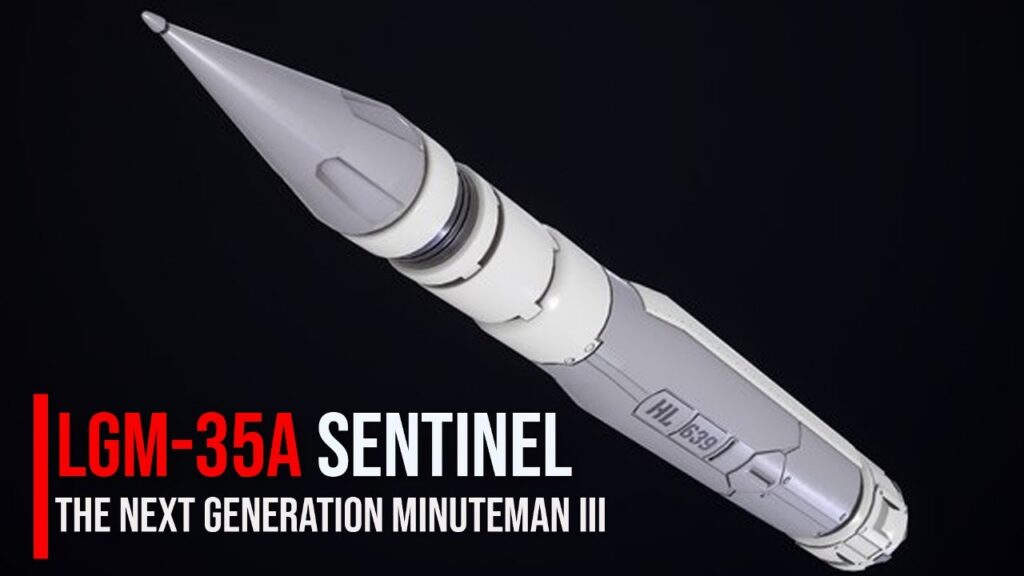
The LGM-35A Sentinel is a next-generation intercontinental ballistic missile (ICBM) currently under development by Northrop Grumman (formerly Orbital ATK) for the United States Air Force (USAF). It is designed to replace the aging LGM-30G Minuteman III ICBM fleet, which has been in service since the 1970s.
The LGM-35A Sentinel is expected to have a range of approximately 9,000 to 10,000 kilometers, allowing it to strike targets across the globe. The missile will carry a payload of up to 5 warheads, with a combined weight of around 5,000 pounds which is about 2,300 kilograms. The warheads are designed to be highly accurate, with a reported circular error probable (CEP) of less than 10 meters.
The LGM-35A Sentinel will feature advanced capabilities such as Multi-warhead. The missile can carry multiple warheads, allowing it to engage multiple targets simultaneously. The missile’s advanced guidance system will enable it to achieve high accuracy, reducing the need for high-yield warheads and lastly, Improved survivability. Here, the Sentinel’s design will incorporate advanced countermeasures to protect against anti-ballistic missile (ABM) systems with an added feature of a flexible payload where it can carry a variety of payloads, including conventional and nuclear warheads.
The LGM-35A Sentinel is expected to reach speeds of up to Mach 23 which is around 27,000 kilometers per hour or 17,000 miles per hour, making it one of the fastest ICBMs in the world. This high speed will enable the missile to quickly traverse long distances and evade enemy defenses.
The LGM-35A Sentinel will be launched from underground silos, similar to the Minuteman III. The USAF plans to build new silos and refurbish existing ones to accommodate the Sentinel. The missile will also be compatible with the existing Minuteman III launch facilities, allowing for a smoother transition.
Other Key Features of the LGM-35A Sentinel:
1. New Propulsion System: The Sentinel will feature a new, more efficient propulsion system, which will provide improved performance and reduced maintenance.
2. Advanced Guidance System: The missile will use a modern guidance system, incorporating GPS, inertial measurement units, and other technologies to achieve high accuracy.
3. Open Architecture: The Sentinel’s design will incorporate an open architecture, allowing for easier integration of future upgrades and technologies.
Development and Timeline
The LGM-35A Sentinel program is currently in the development phase, with Northrop Grumman awarded a contract in 2020 to develop the missile. The USAF plans to begin fielding the Sentinel in the late 2020s, with full operational capability expected in the 2030s.
Russia’s Response to LGM-35A Sentinel
Russia has been actively developing and modernizing its ICBM fleet to counter the United States’ advancements. While there isn’t a direct match for the LGM-35A Sentinel, Russia has several ICBMs that could be considered comparable:
1. R-36M2 Voevoda (SS-18 Satan): A heavy ICBM with a range of over 16,000 km (10,000 miles) and a payload of up to 8 warheads.
2. RS-28 Sarmat (SS-X-30): A new heavy ICBM with a range of over 18,000 km and a payload of up to 15 warheads. The Sarmat is designed to replace the R-36M2 Voevoda.
3. RS-24 Yars (SS-29): A mobile ICBM with a range of over 12,000 km and a payload of up to 4 warheads.
Russia’s ICBMs are designed to be highly capable and survivable, with advanced guidance systems and countermeasures.
Both Russia and the United States are actively developing hypersonic nuclear capabilities, but Russia has made significant strides in recent years.
Russia claims to have already deployed its first hypersonic nuclear-capable missile known as the Avangard (SS-X-47). This is a hypersonic glide vehicle with a reported range of over 20,000 km and a speed of up to Mach 20 which is around 24,000 kilometers per hour.
The United States is also developing hypersonic capabilities which includes:
1. Waverider: A hypersonic glide vehicle program aimed at developing a Mach 5+ capability. Which is around 6,150 kilometers per hour.
2. AGM-183A Air-Launched Rapid Response Weapon (ARRW): A hypersonic missile program focused on developing an air-launched capability.
While both countries are actively developing hypersonic nuclear technology, Russia’s claims of deploying the Avangard missile give them a perceived lead in this area.
However, it’s essential to note that the development and deployment of hypersonic nuclear capabilities are highly classified, and the actual capabilities and timelines may vary.
Keep in mind that the development of hypersonic nuclear technology is a rapidly evolving area, and the situation may change quickly.
Watch the Video Here


Tony is a Aviation, Aerospace and Airplane Geek. He specializes in Aeronautics, Avionics, Military Air Assets, Airliners and Airlines