What is Fly-By-Light? | A Next-Gen Fibre Optic Tech For Cockpits
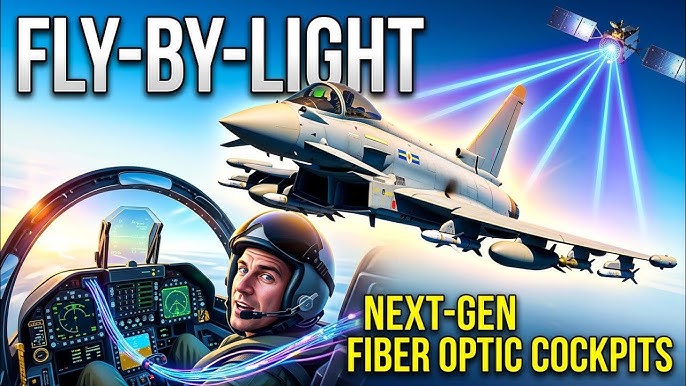
The transition from Fly-By-Wire (FBW) to Fly-By-Light (FBL) represents the next great leap in aviation technology. While FBW revolutionized the industry by replacing heavy mechanical cables with electronic signals, FBL is set to refine this further by replacing copper wiring with fiber optics.
Here is a detailed breakdown of how these systems compare and how fiber optics are reshaping the future of the cockpit.
1. Fly-By-Wire (FBW): The Digital Foundation
Fly-By-Wire technology replaced physical linkages (cables, pulleys, and rods) with an electronic interface. When a pilot moves the sidestick, a computer interprets the movement and sends electrical signals through copper wires to actuators that move the flight control surfaces.
Benefits: Significantly lighter than mechanical systems; allows for “flight envelope protection” (software that prevents dangerous maneuvers).
Limitations: Copper wiring is susceptible to Electromagnetic Interference (EMI) from lightning, solar flares, or high-intensity radio signals. To prevent this, copper wires must be heavily shielded, which adds weight and complexity.
2. Fly-By-Light (FBL): The Optical Leap
Fly-By-Light is essentially the optical version of FBW. Instead of electrical pulses traveling through copper, FBL uses pulses of light traveling through flexible glass or plastic fiber-optic cables.
Immunity to EMI: Unlike copper, fiber optics do not conduct electricity. This makes FBL systems naturally immune to lightning strikes and electromagnetic interference, eliminating the need for heavy shielding.
Weight Reduction: Fiber-optic cables are significantly lighter and thinner than copper. This reduction in “harness weight” directly translates to better fuel efficiency or higher payload capacity.
Massive Bandwidth: Fiber optics can carry much more data at faster speeds than copper. This allows for more complex sensor data to be shared across aircraft systems simultaneously.
3. How Fiber Optics are Changing the Future Cockpit
The shift to FBL isn’t just about the wires; it’s about the capabilities it unlocks for the pilots and the aircraft’s “brain.” Here are the key takeaways:
A. Enhanced Data Integration:
Modern cockpits are becoming increasingly “data-hungry” with the rise of Synthetic Vision Systems, Augmented Reality HUDs, and real-time 4K sensor feeds. The massive bandwidth of fiber optics allows these systems to operate with zero latency, providing pilots with unprecedented situational awareness.
B. Intelligent Damage Compensation:
Because fiber optics can be easily multiplexed (sending multiple signals through one strand), engineers can create highly redundant networks. Some FBL systems are being designed with “self-healing” properties where the software can instantly reroute signals if a fiber is severed, or even compensate for physical wing damage in real-time by adjusting other control surfaces.
C. Simplified Architecture:
Traditional FBW cockpits have massive bundles of wiring (kilometers of it) tucked behind panels. FBL allows for a “bus” architecture where multiple systems (navigation, flight controls, sensors) share a single fiber-optic backbone. This simplifies maintenance and makes it easier to upgrade cockpit hardware—much like “plug-and-play” on a computer.
D. Increased Safety in Extreme Environments:
In military applications, FBL is critical for hardening aircraft against Electronic Warfare and Directed Energy Weapons that could “fry” traditional FBW circuits. In commercial aviation, it provides a much higher safety margin during severe weather and lightning-prone flight paths.
While Fly-By-Wire remains the industry standard today (used by nearly all Boeing and Airbus models), Fly-By-Light is the future of high-performance and next-generation aircraft. As we move toward autonomous flight, electric vertical take-off and landing (eVTOL) vehicles, and hyper-connected cockpits, the speed and security of fiber optics will become a necessity rather than a luxury.
Current Status of Fly-By-Light (FBL) Technology
While Fly-By-Wire (FBW) is the global standard for modern commercial and military jets, Fly-By-Light (FBL) has transitioned from experimental labs to a select few specialized aircraft. However, its adoption is still in the “early growth” stage compared to traditional wiring.
Aircraft Currently Using Fly-By-Light Technology
True Fly-By-Light (where the primary flight control signals are transmitted via fiber) is currently more prevalent in the military and research sectors than in commercial aviation.
Kawasaki P-1 (Japan): This maritime patrol aircraft is the most significant example. It is the first production aircraft in the world to utilize a full Fly-By-Light system for its flight controls.
The Japanese Ministry of Defense chose FBL specifically to ensure the aircraft’s electronics wouldn’t interfere with its sensitive magnetic anomaly detectors used to find submarines.
Kawasaki OH-1 “Ninja”: A light observation helicopter used by the Japan Ground Self-Defense Force. It was a pioneer in using FBL to reduce electromagnetic interference (EMI).
Lockheed Martin F-35 Lightning II: While technically a hybrid, the F-35 uses a massive fiber-optic backbone (IEEE 1394b) for its mission systems, sensors, and data fusion.
While some control loops still rely on high-speed copper, the sheer volume of data handled by light makes it a “Light-Integrated” platform.
NASA Research Aircraft: NASA has spent decades testing FBL on modified F-18s and other testbeds under programs like the Fly-By-Light Advanced Systems Hardware (FLASH) project.
Aviation Companies Currently Working on FBL
The “Big Players” in aerospace are all investing in FBL, though they often use different terminology, such as Photonic Avionics or Optical Computing.
Kawasaki Heavy Industries: Currently the world leader in successfully integrating FBL into production-ready airframes.
Lockheed Martin & Northrop Grumman: Heavily focused on integrating fiber optics for military stealth and electronic warfare (EW) resistance.
Airbus: Airbus has conducted extensive research into “Optical FBW.” They are looking at FBL as a way to reduce the weight of their next generation of “Ultra-Efficient” aircraft.
Boeing: Boeing uses fiber optic networks in the seven eight seven Dreamliner and the triple seven X for the Aircraft Information Management System (AIMS), though they still lean on copper for many primary flight control surfaces due to maintenance familiarity.
Honeywell and Thales: These major avionics providers are developing the “black boxes” and sensors that speak in light pulses rather than electricity.
Safran and Leonardo: These European firms are researching FBL for next-generation helicopters to reduce weight and improve safety in high-intensity electromagnetic environments (like operating near navy ship radars).
Is Fly-By-Light a “Next-Generation” Technology?
Absolutely, yes. It is considered the “Next-Gen” successor to Fly-By-Wire. Here is why it is categorized that way:
A. The “More Electric Aircraft” (MEA) Initiative
As the industry moves toward electric propulsion and more electrical systems (replacing hydraulics), the cockpit becomes crowded with electrical noise. FBL is the “Next-Gen” solution to manage this noise without adding tons of heavy lead/copper shielding.
B. Bandwidth for AI and Autonomous Flight
Next-gen aircraft will require massive amounts of data from LIDAR, 4K cameras, and AI processing units to fly themselves or assist pilots. Copper wiring simply cannot handle the data gigabits required for these systems; fiber optics (FBL) is the only medium capable of supporting that “pipe” of information.
C. Sustainability Goals
Airlines are desperate to reduce weight to achieve “Net Zero” carbon goals. Replacing kilometers of copper with thin glass fibers can shave hundreds (or even thousands) of pounds off a large airframe. This makes FBL a cornerstone of next-generation green aviation.
The Hurdle: Why isn’t it on every plane yet?
If it’s “Next-Gen,” why isn’t it everywhere? The primary reason is Maintenance.
Splicing: You can fix a copper wire with a simple crimp tool in a field hangar. Fixing a severed fiber-optic cable requires specialized laser-splicing equipment and a pristine, dust-free environment.
Fragility: While fiber is strong, it can’t be bent at sharp 90-degree angles like copper, requiring new airframe design standards.
We are currently in a “Hybrid Era” where planes use copper for flight controls but fiber for data. The Next-Generation will see the “Full FBL” transition, where electricity is used only for power, and light is used for every thought and movement the aircraft makes.


Tony is a Aviation, Aerospace and Airplane Geek. He specializes in Aeronautics, Avionics, Military Air Assets, Airliners and Airlines