How the Landing Gear of Boeing 777X Works
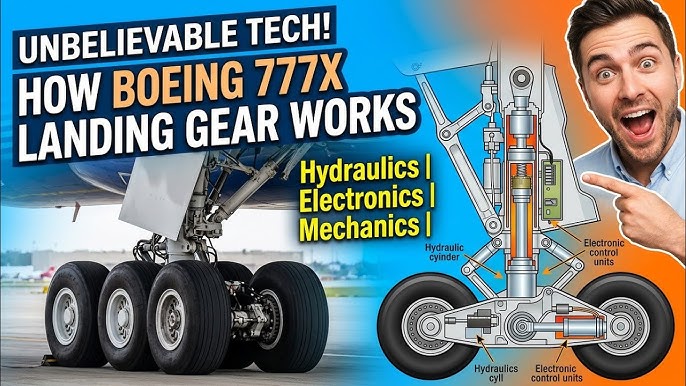
The landing gear of Boeing 777X specifically the 777-9 and 777-8 is a marvel of heavy-duty engineering. It is designed to support the heaviest twin-engine jet in the world while allowing a massive aircraft to navigate tight airport taxiways designed for smaller planes.
Watch the Video Here
It is an evolution of the landing gear found on the triple seven-300ER, but strengthened and refined to handle the 777X’s increased Maximum Takeoff Weight of roughly 351,500 kg.
The “Six-Wheel Bogie”
The landing gear of Boeing 777X utilizes a tri-cycle configuration, consisting of two Main Landing Gear units which are located under the wings. Each unit features a six-wheel “bogie” (or truck), for a total of 12 main wheels and One Nose Landing Gear (NLG) unit which is Located under the cockpit, featuring two wheels.
The use of 12 main wheels is critical for “Pavement Loading.” By spreading the aircraft’s immense weight across more tires, Boeing ensures the triple seven X can land at existing airports without cracking the concrete of the runways or taxiways.
The Semi-Levered Gear (For Takeoff)
One of the most advanced features of the landing gear of boeing 777X is its semi-levered design. During the takeoff roll, as the pilot pulls back on the stick to rotate, a hydraulic actuator “locks” the aft part of the wheel bogie.
This effectively shifts the pivot point of the aircraft from the center of the bogie to the rear axle. This allows the 777X to rotate at a higher angle without the tail striking the runway. It enables the aircraft to take off from shorter runways despite its massive length.
Aft-Axle Steering (The “Shopping Cart” Logic):
The Boeing 777-9 is incredibly long over 250 feet. Without a special steering mechanism, the main wheels would “scrub” (drag sideways) and suffer extreme wear during tight turns on the ground.
The rear-most axle of each 6-wheel main bogie is steerable. When the pilot turns the nose wheel beyond a certain angle (usually 13 degrees), the aft axles on the main gear automatically turn in the opposite direction of the nose.
This reduces the turning radius significantly and prevents the tires from being shredded by lateral friction.
The Shock Absorption mechanism is stunning. Here, the Oleo-Pneumatic Strut is used to cushion the impact of landing, each gear uses a massive oleo strut. It uses a combination of Nitrogen gas for springiness and Hydraulic fluid for damping.
When the Boeing 777X touches down, the weight of the aircraft forces the fluid through small holes inside the strut, converting the kinetic energy of the descent into heat, ensuring the passengers feel a smooth “thump” rather than a violent jar.
The Braking and Material Science
The Use of Carbon Brakes: Every one of the 12 main wheels is equipped with a multi-disc carbon brake assembly. Carbon is used because it can withstand the extreme heat generated when stopping 350 tons of aircraft—temperatures that would melt steel.
The Digital Anti-Skid: Similar to ABS in a car, the 777X monitors the rotation of each wheel. If one wheel begins to skid, the system pulses the hydraulic pressure to that brake to maintain maximum friction and prevent tire blowouts.
The High-Strength Steel & Titanium: The main “post” of the gear is forged from a single piece of ultra-high-strength steel alloy, while many of the linkage components are made of titanium to save weight while maintaining extreme durability.
The Retraction Process
Because the boeing 777X is so large, the wheel wells, that is the “garages” for the gear) are massive. The main gear retracts inward toward the fuselage’s center line.
Before retraction, the wheel bogies automatically tilt to a specific angle where the front wheels are up and the rear wheels are down. This ensures the 15-foot-long bogie fits into the shaped cavity of the belly.
The Gear Doors: The doors are “sequenced.” They open to let the gear out/in and then close tightly to maintain the aircraft’s aerodynamic “clean” shape to save fuel during flight.
The Boeing 777X is a highly advanced aircraft that relies on complex systems to ensure efficient and safe operations. Here’s an overview of how the hydraulic, electrical, and mechanical systems interact to facilitate efficient landing and takeoff:
The Hydraulic System
The 777X has a triplex hydraulic system, consisting of three independent systems (A, B, and C). Each system powers various aircraft functions, including:
1. Flight Control Surfaces: Hydraulic actuators control the movement of ailerons, elevators, and rudder.
2. Landing Gear: Hydraulic systems extend and retract the landing gear, as well as operate the gear brakes.
3. Flaps and Slats: Hydraulic actuators control the movement of flaps and slats during takeoff and landing.
During landing and takeoff, the hydraulic system powers the flight control surfaces to maintain stable flight and control.
It also extends and retracts the landing gear, flaps, and slats as required.
The Electrical System
The Boeing 777X has a complex electrical system that powers various aircraft functions, including:
1. Flight Control Computers: The electrical system powers the flight control computers, which process data and send commands to the hydraulic actuators.
2. Avionics: The electrical system powers avionics systems, including navigation, communication, and display systems.
3. Actuators and Motors: The electrical system powers various actuators and motors, including those used for landing gear extension and retraction.
During landing and takeoff, the electrical system powers the flight control computers to ensure stable flight and control and provides power to avionics systems, which aid in navigation and communication.
The Mechanical System
The triple X has a complex mechanical system that includes:
1. Engines: The aircraft is powered by two General Electric GE9X engines, which provide thrust during takeoff and cruise.
2. Gearboxes and Shafts: The mechanical system includes gearboxes and shafts that transmit power from the engines to the propellers or fans, in the case of the triple X’s high-bypass turbofans.
3. Landing Gear and Brakes: The mechanical system includes the landing gear and brakes, which are actuated by the hydraulic system.
During landing and takeoff, the mechanical system provides thrust through the engines. Transmits power from the engines to the fans.
The hydraulic, electrical, and mechanical systems interact to provide efficient landing and takeoff:
1. Autothrottle: The electrical system powers the autothrottle, which adjusts engine thrust during takeoff and landing to optimize performance.
2. Flight Control: The hydraulic system powers the flight control surfaces, while the electrical system powers the flight control computers, which process data and send commands to the hydraulic actuators.
3. Landing Gear and Flaps: The hydraulic system extends and retracts the landing gear and flaps, while the electrical system powers the actuators and motors that control these systems.
In summary, the hydraulic, electrical, and mechanical systems of the Boeing triple seven X interact to provide efficient landing and takeoff by Powering flight control surfaces and actuators, providing thrust through the engines, Controlling landing gear, flaps, and slats and Enabling autothrottle and flight control computer functions.
These systems work together to ensure safe and efficient operations during landing and takeoff.


Tony is a Aviation, Aerospace and Airplane Geek. He specializes in Aeronautics, Avionics, Military Air Assets, Airliners and Airlines