Applications of Bernoulli’s Principle in Aviation and Aerodynamics
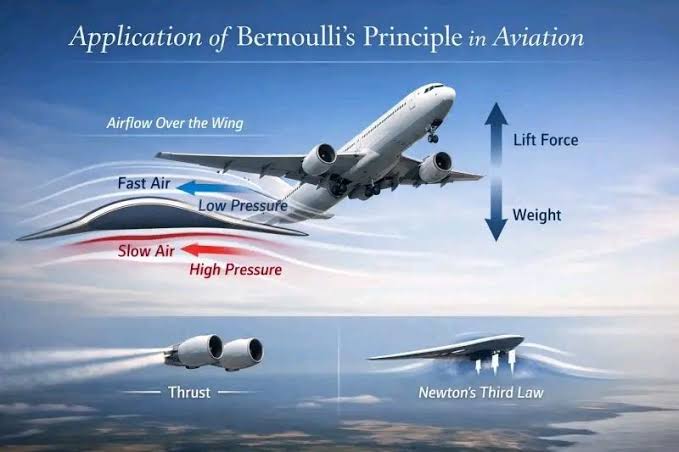
Bernoulli’s Principle is one of the cornerstones of fluid dynamics and is arguably the most famous physical law in aviation. Named after the Swiss mathematician Daniel Bernoulli, the principle states that within a horizontal flow of fluid (like air), an increase in the velocity of the fluid occurs simultaneously with a decrease in static pressure.
In the context of aviation and aerospace, this relationship between speed and pressure is the primary mechanism used to explain how aircraft stay aloft and how critical flight instruments function.
1. The Core Principle: Bernoulli’s Equation. For an incompressible, non-viscous fluid in steady flow, the relationship is expressed as:
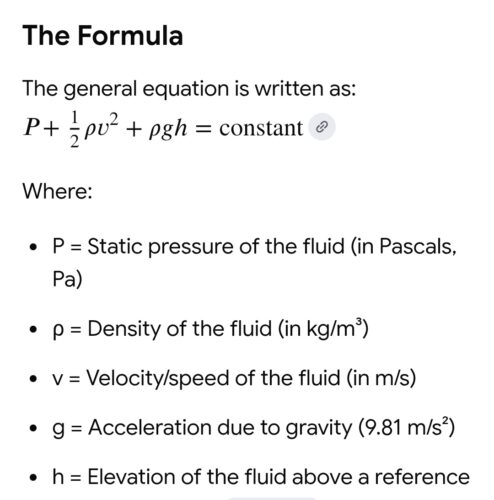
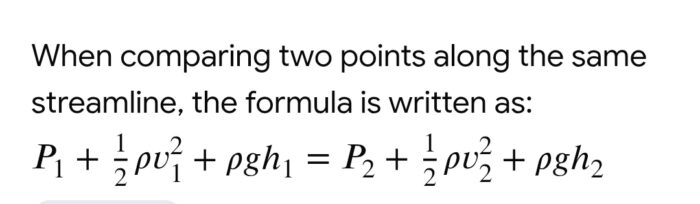
The potential energy is usually negligible in air flow over a wing.
If dynamic pressure (speed) goes up, static pressure must go down to keep the total energy constant.
2. Major Application: The Generation of Lift. The most significant application of Bernoulli’s theory is the design of airfoils (wings).
Shape and Velocity: An airfoil is shaped with a curved upper surface. As air approaches the leading edge of a wing, it is forced to divide. Due to the shape and the “Coanda Effect,” the air traveling over the curved top surface moves significantly faster than the air moving across the relatively flatter bottom surface.
Pressure Differential: According to Bernoulli, because the air on top is moving faster, its static pressure drops. The air underneath move slower, maintaining a higher static pressure.
Lift Force: This pressure imbalance creates a net upward force. The high pressure under the wing literally “pushes” the wing into the low-pressure area above it.
While Bernoulli explains the pressure aspect of lift, it is usually taught alongside Newton’s Third Law (Downwash/Action-Reaction) to provide a complete picture of aerodynamics.
3. Application: The Pitot-Static System. Every aircraft, from a Cessna to a Boeing 787, relies on Bernoulli’s principle to tell the pilot how fast they are flying.
The Pitot Tube: This is a forward-facing tube that captures “Ram Air.” It measures Total Pressure (Static + Dynamic).
The Static Port: This is a flush-mounted hole on the side of the fuselage that measures ambient atmospheric pressure (Static Pressure).
Airspeed Indicator: The instrument subtracts the Static Pressure from the Total Pressure. The remaining value is the Dynamic Pressure, which is directly proportional to the aircraft’s speed (v^2). Without Bernoulli’s math, we would have no reliable way to measure speed through a fluid medium (air).
4. Application: The Venturi Effect and Carburetors
In older piston-engine aircraft (and many small trainers today), Bernoulli’s theory is used to mix fuel and air.
The Venturi: The carburetor contains a “throat” or a narrow restriction. As air is sucked into the engine, it must speed up to pass through this narrow part.
Pressure Drop: As the air speeds up in the Venturi, its pressure drops significantly.
Fuel Suction: This low-pressure area acts as a vacuum, drawing fuel out of a nozzle and atomizing it into the air stream to be burned in the cylinders.
5. Application in Aerospace: Rocket Nozzles. While Bernoulli’s simplified equation applies to “incompressible” flow (low-speed flight), its principles are adapted for the compressible flow found in rocket engines.
De Laval Nozzles: Rocket engines use convergent-divergent nozzles. In the convergent section, subsonic exhaust gases are accelerated.
Pressure Exchange: The nozzle converts the high-pressure, high-temperature gas stored in the combustion chamber into high-velocity kinetic energy. This exchange of pressure for velocity is the fundamental “Bernoullian” logic that provides the thrust required to reach orbit.
6. Significance in Design and Safety: Beyond just “making things fly,” Bernoulli’s theory is vital for:
Stall Prediction: Designers use the principle to determine the “Critical Angle of Attack.” If the angle is too high, the smooth, fast-moving air on top of the wing breaks away (turbulent flow), the pressure differential vanishes, and the wing loses lift.
Structural Engineering: Aeronautical engineers must calculate the pressure loads on the “skin” of an aircraft. Bernoulli’s equations help determine how much stress a wing must endure at high speeds due to the massive pressure differences between the top and bottom surfaces.
In aviation, Bernoulli’s theory is the Law of Trade-Offs. It tells us that we can “trade” the pressure of the atmosphere for speed, and in doing so, we gain the ability to measure our movement, mix our fuel, and generate the force required to lift thousands of tons into the sky.
The Bernoulli Principle, named after the Dutch-Swiss mathematician Daniel Bernoulli, is a fundamental principle in fluid dynamics that describes the relationship between the velocity and pressure of a moving fluid. It states that as the velocity of a fluid increases, the pressure decreases, and vice versa. This principle is widely used in a variety of engineering and scientific applications, including the design of aircraft, automobiles, and ships, as well as in the analysis of fluid flow in pipes and channels.
The Bernoulli Principle has a wide range of Applications in various fields. They include:
Aeronautics
The Bernoulli principle is used to explain the lift generated by an airplane wing. As the air flows over the wing, it is deflected downward, resulting in an increase in velocity and a decrease in pressure. This difference in pressure between the upper and lower surfaces of the wing generates lift, allowing the airplane to take off and fly.
Automotive Engineering
The Bernoulli principle is used to design the shape of the body and the air intake of a car to reduce drag and improve fuel efficiency.
Marine Engineering
The Bernoulli Principle is used to design the shape of ships and boats to reduce drag and improve their speed and efficiency.
Limitations
Despite its widespread use and success, the Bernoulli principle has some limitations. It is based on the assumption that the fluid is incompressible, which means that its density remains constant. However, this assumption is not always valid, particularly at high speeds or high altitudes where the effects of compressibility become significant. In addition, the Bernoulli principle does not take into account the viscous forces that act on the fluid, which can significantly affect the flow of the fluid.
When using the Bernoulli principle, it is important to consider the following factors:
The Properties of the Fluid
The Bernoulli equation is based on the density and viscosity of the fluid. These properties can significantly affect the flow of the fluid and should be taken into account when applying the Bernoulli principle.
The Shape and Size of the Object
The shape and size of the object can significantly affect the flow of the fluid around it. For example, a streamlined object with a smooth surface will experience less drag than a rough, irregularly shaped object.
The Flow Conditions
The Bernoulli principle assumes that the fluid is flowing smoothly and uniformly. However, in some cases, the flow may be turbulent or non-uniform, which can affect the accuracy of the Bernoulli equation.
The Bernoulli principle is a fundamental principle in fluid dynamics that describes the relationship between the velocity and pressure of a moving fluid. It has a wide range of applications in various fields, including aeronautics, automotive engineering, and marine engineering.
However, it has some limitations, including the assumption of incompressibility and the neglect of viscous forces.
It is important to consider the properties of the fluid, the shape and size of the object, and the flow conditions when applying the Bernoulli principle to a specific problem or situation.
What are the Applications of the Bernoulli Principle?
The Bernoulli principle has a wide range of applications in various fields, including aeronautics, automotive engineering, and marine engineering. It is used to explain the lift generated by an airplane wing, to design the shape of the body and the air intake of a car to reduce drag, and to design the shape of ships and boats to reduce drag and improve their speed and efficiency.
What are the Limitations of the Bernoulli Principle?
The Bernoulli principle has some limitations, including the assumption of incompressibility and the neglect of viscous forces. It is based on the assumption that the fluid is incompressible, which means that its density remains constant.
However, this assumption is not always valid, particularly at high speeds or high altitudes where the effects of compressibility become significant. In addition, the Bernoulli principle does not take into account the viscous forces that act on the fluid, which can significantly affect the flow of the fluid.
What factors should be considered when using the Bernoulli principle?
When using the Bernoulli principle, it is important to consider the properties of the fluid, the shape and size of the object, and the flow conditions. The Bernoulli equation is based on the density and viscosity of the fluid, and these properties can significantly affect the flow of the fluid.
In addition, the shape and size of the object can significantly affect the flow of the fluid around it, and the flow conditions, such as whether the flow is smooth or turbulent, can also affect the accuracy of the Bernoulli equation.


Tony is a Aviation, Aerospace and Airplane Geek. He specializes in Aeronautics, Avionics, Military Air Assets, Airliners and Airlines