How Hypersonic Air-Breathing Scramjet Engines Work
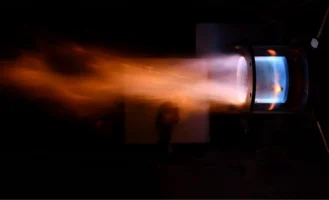
A hypersonic air-breathing propulsion system, primarily a scramjet (supersonic combustion ramjet) or dual-mode ramjet above Mach 5, generates thrust by using the vehicle’s extreme forward speed to compress incoming air without rotating compressors or turbines.
Unlike a conventional ramjet, which slows intake air to subsonic speeds before burning fuel and loses efficiency around Mach 5 to 6 due to shock-wave heating and pressure losses, a scramjet keeps airflow supersonic throughout the combustor.
Core Components and Operating Stages:
1. The Inlet and Diffuser: Its Shaped geometry captures high-speed atmospheric air and creates a series of oblique shock waves.
These shocks convert kinetic energy into higher pressure and temperature while slowing the flow, to subsonic speeds in a standard ramjet, or to a still-supersonic speed in a scramjet.
2. The Combustor: Fuel, often hydrogen or specialized hydrocarbons, is injected into the compressed airstream and ignited.
Because air moves through at high speed, fuel mixing and ignition must occur rapidly within milliseconds, often aided by flame holders or cavities to stabilize combustion.
3. The Exhaust Nozzle: Hot, high-pressure combustion gases expand through a diverging or converging-diverging nozzle. Accelerating this exhaust rearward creates forward thrust via Newton’s third law.
The key Operational Challenges of a hypersonic Air-Breathing Engine:
Firstly, the Need for a Booster: Because compression depends on high-speed airflow, ramjets and scramjets produce little or no thrust at zero or low speeds.
A rocket booster or carrier aircraft typically accelerates the vehicle to supersonic or hypersonic speeds first.
Secondly, the Extreme Thermal and Shock Loads: Hypersonic flight generates intense aerodynamic heating and strong shock waves.
Engines require heat-resistant materials, active cooling (sometimes using fuel as a coolant), and precise inlet geometry to prevent unstart, where shock waves expel out of the intake and disrupt airflow.
Thirdly, the Air-Breathing Advantage: Carrying only fuel rather than both fuel and an oxidizer (as rockets do) reduces launch weight for atmospheric flight, as explained in NASA’s Ramjet Thermodynamic Cycle guide.
Hypersonic air-breathing ramjet and scramjet engines power both experimental research aircraft and operational or developmental hypersonic cruise missiles, with notable examples including the NASA X-43A, Boeing X-51A Waverider, 3M22 Zircon, and Hypersonic Attack Cruise Missile (HACM).
Because these engines rely on extreme forward speed to compress incoming air, nearly all of these platforms use a rocket booster or high-altitude carrier aircraft to reach ignition speed first.
Experimental Research Aircraft and Demonstrators that use hypersonic Air-Breathing technology:
1. NASA X-43A (Hyper-X): Launched from a B-52B bomber and accelerated by a Pegasus rocket booster, this uncrewed lifting-body aircraft set the world air-breathing speed record by reaching Mach 9.6 which is roughly 7,000 miles per hour in November 2004 using a hydrogen-fueled scramjet, as detailed on NASA’s X-43A Reference Page.
2. Boeing X-51A Waverider: Unlike the hydrogen-fueled X-43A, this U.S. Air Force demonstrator burned storable JP-7 hydrocarbon jet fuel in an Aerojet Rocketdyne scramjet.
In May 2013, it achieved the longest air-breathing hypersonic flight of its era by cruising at Mach 5.1 for 210 seconds, according to the U.S. Air Force X-51A Fact Sheet.
3. India’s HSTDV (Hypersonic Technology Demonstrator Vehicle): Developed by India’s Defence Research and Development Organisation, this uncrewed scramjet demonstrator validates sustained Mach 6+ flight and actively cooled combustor technology for future indigenous hypersonic cruise missiles, as reported in The Times of India’s Hypersonic Defense Report.
4. Hypersonix Delta-Velos: An Australian reusable technology demonstrator designed around the 3D-printed, hydrogen-fueled SPARTAN scramjet engine, targeting speeds up to Mach 12 for satellite launch and hypersonic research, according to Embry-Riddle’s Aerospace History Text.
Operational and Developmental Missiles Using Hypersonic Air-Breathing Technology:
1. The 3M22 Zircon (Tsirkon): This missile is Deployed on Russian Navy warships, this scramjet-powered hypersonic cruise missile travels at Mach 6 to 8 over an estimated range of up to 1,000 km.
It is recognized as the first scramjet-powered weapon used in combat, according to AeroCorner’s 2026 Hypersonic Missiles Overview.
2. The Hypersonic Attack Cruise Missile (HACM): Built by RTX (Raytheon) and Northrop Grumman following DARPA’s HAWC program, this air-launched scramjet cruise missile is designed for U.S Air Force fighter aircraft like the F-15E and F-15EX. Joint flight testing with Australia began in 2026 ahead of a planned 2027 fielding decision.
3. BrahMos-II: This is a joint Indo-Russian hypersonic cruise missile project building on the supersonic ramjet-powered BrahMos. It is designed to use a scramjet engine to reach speeds of Mach 7 to 8.
4. The ASN4G: This is a next-generation, air-launched nuclear cruise missile under development in France that uses dual-mode ramjet and scramjet propulsion to achieve hypersonic speeds.
High-Speed Ramjet Predecessors of Mach 3 to Mach 5 Speed Range:
Lockheed SR-71 Blackbird with its Pratt and Whitney J58 engines operated as turbojets at low speeds and transitioned into a turboramjet mode at Mach 3.2, routing intake air directly around the turbine core into the afterburner.
While the BrahMos and RIM-8 Talos which are Supersonic missiles like the Indo-Russian BrahMos with speed of Mach 2.8 to 3 and the historic U.S Navy RIM-8 Talos of Mach 2.7 demonstrate classic liquid-fueled ramjet propulsion, bridging the speed gap just below the Mach 5 hypersonic threshold.
Since these engines rely on the vehicle’s speed to compress the air, they cannot produce thrust from a standstill.
A scramjet-powered vehicle must first be accelerated to supersonic speeds (usually Mach 4+ by a booster rocket or a separate turbojet engine before the air-breathing scramjet can take over.


Tony is a Aviation, Aerospace and Airplane Geek. He specializes in Aeronautics, Avionics, Military Air Assets, Airliners and Airlines