Differences Between an Atomic Bomb and a Hydrogen Bomb
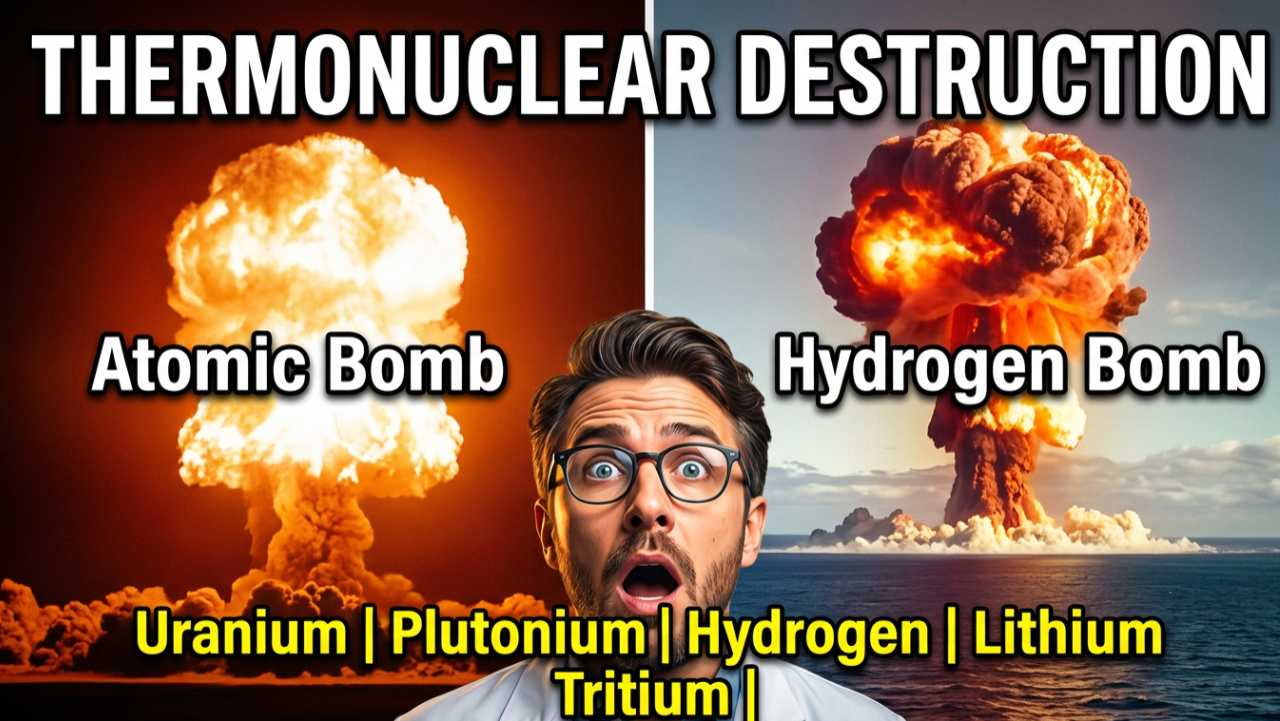
The primary difference between an atomic bomb and a hydrogen bomb lies in their nuclear reaction mechanisms and energy yields.
An atomic bomb, also known as an A-bomb, uses nuclear fission to release energy. Fission occurs when an atomic nucleus splits into two or more smaller nuclei, releasing a large amount of energy in the process. The first atomic bombs, like those dropped on Hiroshima and Nagasaki, used uranium-235 or plutonium-239 as fuel. The fission reaction releases a significant amount of energy, but the yield is relatively limited compared to a hydrogen bomb.
A hydrogen bomb, also known as an H-bomb or thermonuclear bomb, uses nuclear fusion to release energy. Fusion occurs when two or more atomic nuclei combine to form a single, heavier nucleus, releasing even more energy than fission. The primary fuel used in H-bombs is a combination of deuterium and tritium, isotopes of hydrogen. The fusion reaction releases a massive amount of energy, making H-bombs significantly more powerful than A-bombs.
Key Differences:
1. Energy yield: H-bombs have a much higher energy yield than Atomic-bombs. While A-bombs typically have yields in the range of kilotons of TNT, Hydrogen-bombs can have yields in the range of megatons of TNT.
2. Nuclear reaction: A-bombs use fission, while H-bombs use fusion.
3. Fuel: A-bombs use U-235 or Pu-239, while H-bombs use Deuterium and Tritium isotopes of hydrogen.
4. Size and weight: H-bombs are generally larger and heavier than A-bombs due to the complexity of the fusion reaction.
Launch Platforms:
Both atomic and hydrogen bombs can be delivered via various launch platforms:
1. Strategic bombers: Large aircraft, like B-2, B-52, or Tu-95, can carry nuclear bombs and deliver them to targets.
2. Intercontinental ballistic missiles: Land-based ICBMs, like Minuteman III or Topol-M, can carry nuclear warheads and strike targets at long ranges.
3. Submarine-launched ballistic missiles: Nuclear-powered submarines can launch ballistic missiles, like Trident or Bulava, carrying nuclear warheads.
4. Cruise missiles: Air-breathing cruise missiles, like Tomahawk or Kh-55, can be equipped with nuclear warheads.
Destructive Effects and Damage Capabilities:
The destructive effects of nuclear bombs depend on several factors, including the type of bomb, yield, altitude of detonation, and distance from the target.
The shockwave generated by the explosion can cause widespread destruction, including damage to buildings, infrastructure, and injuries to people. The intense heat generated by the explosion can cause burns, fires, and damage to materials. Nuclear bombs emit ionizing radiation, including gamma rays and X-rays, which can cause radiation sickness and long-term health effects.
In terms of Long-term Effects, Radioactive particles can be carried by the wind, contaminating large areas and causing long-term health effects. Nuclear bombs can contaminate soil, water, and air, leading to long-term environmental damage.
Comparative Damage Capabilities:
Assuming a 1-kiloton A-bomb and a 10-megaton H-bomb, The 1-kiloton A-bomb would have a blast radius of approximately 1.2 miles and a radiation radius of 3.5 miles. The 10-megaton H-bomb would have a blast radius of approximately 6.2 miles and a radiation radius of 12.4 miles.
The H-bomb’s destructive effects would be significantly greater than those of the A-bomb, with a much larger blast radius and radiation radius.
Keep in mind that the actual effects of a nuclear explosion depend on various factors, including the specific bomb design, altitude of detonation, and environmental conditions. These estimates are simplified and intended to illustrate the general differences between atomic and hydrogen bombs.
The Chemistry of Atomic and Hydrogen Bombs:
The chemistry of an atomic bomb involves nuclear fission, a process where an atomic nucleus splits into two or more smaller nuclei, releasing a large amount of energy. The most commonly used fuels in A-bombs are:
1. Uranium-235: A fissile isotope of uranium that undergoes a chain reaction of nuclear fission when bombarded with neutrons.
2. Plutonium-239: A fissile isotope of plutonium that also undergoes a chain reaction of nuclear fission.
The fission reaction involves the following steps:
1. Neutron absorption: A neutron collides with the nucleus of a U-235 or Pu-239 atom, causing it to absorb the neutron.
2. Nuclear fission: The nucleus splits into two or more smaller nuclei, releasing more neutrons and a large amount of energy.
3. Chain reaction: The released neutrons collide with other nuclei, causing a chain reaction of fission reactions.
The chemistry of a hydrogen bomb involves nuclear fusion, a process where two or more atomic nuclei combine to form a single, heavier nucleus, releasing a large amount of energy. The most commonly used fuels in H-bombs are:
1. Deuterium: A heavy isotope of hydrogen with one proton and one neutron in its nucleus.
2. Tritium: A rare isotope of hydrogen with one proton and two neutrons in its nucleus.
The fusion reaction involves the following steps:
1. Deuterium-tritium reaction: A Deuterium nucleus combines with a Tritium nucleus to form a nucleus of helium-4 and a high-energy neutron.
2. Energy release: The fusion reaction releases a large amount of energy, which is harnessed to create the explosive force of the H-bomb.
Examples of atomic bombs include:
1. Little Boy (Uranium-235) which was dropped on Hiroshima, Japan on August 6, 1945
2. Fat Man (Plutonium-239) which was dropped on Nagasaki, Japan on August 9, 1945
Examples of hydrogen bombs include:
Ivy Mike, the first thermonuclear bomb tested by the United States on November 1, 1952 and Castle Bravo, the first deployable H-bomb which was tested by the United States on March 1, 1954
Hydrogen bombs can be identified by their High energy yield as they have a much higher energy yield than Atomic bombs, often in the range of hundreds of kilotons to megatons. They often have a Two-stage design with a primary fission stage that compresses a secondary fusion stage.
Has any nation used a hydrogen bomb before?
The answer is yes. The United States has used a hydrogen bomb before. On March 1, 1954, the United States tested the Castle Bravo hydrogen bomb at Bikini Atoll in the Marshall Islands. The test was a success, and the bomb had a yield of 15 megatons, significantly higher than expected.
The Soviet Union also tested its first hydrogen bomb, Joe 8, on August 12, 1953. France and China have also developed and tested hydrogen bombs.
However, it’s worth noting that the use of hydrogen bombs in combat has been limited, and most nuclear tests have been conducted for research and development purposes. The devastating effects of nuclear weapons have led to international efforts to control and disarm nuclear arsenals.


Tony is a Aviation, Aerospace and Airplane Geek. He specializes in Aeronautics, Avionics, Military Air Assets, Airliners and Airlines