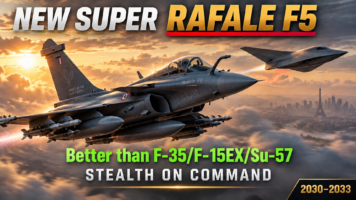
F-15EX: How the US Built a Monster Fighter-Bomber in the F-15EX

The F-15E Strike Eagle is a proven, two-seat, dual-role fighter that first entered service in the late 1980s. The F-15EX Eagle II is its modern, heavily upgraded successor, essentially a brand-new aircraft built on the F-15E’s airframe but with completely modernized systems.
The F-15EX has a fully digital glass cockpit with large-area touchscreen displays of 10″ x 8″ touchscreens, a digital fly-by-wire flight control system as the F-15E has analog and hybrid controls, and the Advanced Display Core Processor II, the world’s fastest fighter jet computer.
The F-15E has older, more traditional analog gauges and smaller MFDs.
The F-15EX uses the AN-APG-82(V)1 AESA radar, which is vastly superior to the F-15E’s mechanically scanned APG-70 radar. The AESA gives the EX much better range, tracking, electronic warfare resistance, and simultaneous air-to-air/air-to-ground capability.
The F-15EX carries the Eagle Passive Active Warning Survivability System, a state-of-the-art Digital Electronic Warfare suite. The F-15E has the older, less capable Tactical Electronic Warfare System.
Open Mission Systems (OMS): The F-15EX uses an open architecture, making it much easier and cheaper to upgrade with new software and weapons over time. The F-15E is largely locked into its original architecture.
The F-15EX can carry up to 22 air-to-air missiles using AMBER racks on the wing pylons or a massive 29,500 pounds of ordnance. The F-15E carries about 23,000 pounds
The F-15EX also supports newer weapons like the AIM-9X, AIM-120D, and hypersonic missiles natively.
The F-15EX is a fighter-bomber, just like the F-15E, fighter-bomber it’s a dramatically more capable one. Its key capabilities include:
1. Air Superiority: It can carry a huge number of air-to-air missiles of up to 22, making it a formidable “missile truck” that can support stealth fighters like the F-22 and F-35 by carrying extra ordnance and sharing targeting data.
2. Deep Strike: It can deliver precision-guided bombs, cruise missiles, and hypersonic weapons over long ranges (its combat radius is roughly 700+ nautical miles without refueling).
3. Electronic Warfare: The EPAWSS system gives it advanced jamming, deception, and threat detection capabilities, allowing it to survive in contested environments.
4. Networked Warfare: It can act as a “quarterback” in the sky, fusing data from other aircraft, satellites, and ground stations, and sharing that picture with teammates.
5. High Speed & Maneuverability: It can exceed Mach 2.5 and, while not as agile as an F-22, it’s still a very capable dogfighter thanks to its thrust-to-weight ratio.
Which of the Two Jets Is A Fighter-Bomber?
Both are fighter-bombers. The F-15E was originally designed as a dual-role fighter, equally capable of air-to-air combat and air-to-ground attack.
The F-15EX carries that same philosophy forward but with modern technology. Neither is a pure air-superiority fighter like the F-22 nor a pure bomber like the B-2. They’re both designed to do both jobs well.
How Lethal is the F-15EX?
The F-15EX is extremely lethal and arguably the most lethal non-stealth fighter ever built.
In air-to-air Combat, with 22 missiles, the AIM-120D AMRAAMs and AIM-9X Sidewinders, it can engage more targets at longer ranges than almost any other fighter. Its AESA radar can track and engage multiple targets simultaneously.
In a beyond visual range fight, the F-15EX it’s a nightmare for opponents.
In an air-to-ground combat, It can carry a massive payload of precision munitions, including 5,000 pound bunker-busters, SDBs, Small Diameter Bombs, and hypersonic weapons.
It can strike hardened targets, moving targets, and area targets with high accuracy.
The Eagle Passive Active Warning Survivability System and Digital Electronic Warfare suite mean it can detect, jam, and evade enemy radar and missiles far better than the F-15E. It’s not stealthy, but it’s very hard to kill.
Because of its open architecture, it can rapidly integrate new weapons and countermeasures as threats evolve. It won’t become obsolete quickly.
The F-15EX is a 4.5+ generation fighter that can hold its own against 5th-generation threats when supported properly.
It’s not a stealth aircraft, so it’s not meant to penetrate the most heavily defended airspace alone, but in a networked fight alongside F-35s and F-22s, it’s a devastatingly lethal platform.
The first operational F-15EXs were delivered to the 142nd Wing (Oregon Air National Guard) in 2024, replacing their aging F-15C and F-15Ds.
The aircraft has been undergoing operational testing, training missions, and integration into existing squadrons.
It has participated in exercises like Northern Edge and Red Flag, where it has reportedly performed very well, demonstrating its ability to carry large weapons loads of up to 12 AIM-120 AMRAAMs or 7,500+ pounds of bombs, its advanced electronic warfare suite (EPAWSS), and its long-range sensor fusion capabilities.
However, no F-15EX has been sent into active combat operations like airstrikes or air-to-air engagements as of this date.
So while the F-15EX has excelled in training and exercises, particularly in air superiority scenarios where its massive missile loadout and AESA radar give it an edge, it hasn’t yet had a real-world combat mission to prove itself in.
That will likely come in the next few years as more units stand up and operational deployments begin.
Let’s look at what aircraft are in the same league as the F-15EX and whether any can truly match it.
Aircraft Comparable to the F-15EX
The F-15EX is a unique beast. It’s a heavy, non-stealth, air-superiority-and-strike fighter with massive payload, long range, and cutting-edge avionics. The closest competitors are:
1. The Su-35S Flanker-E: It has very similar philosophy with this Russian jet. It is heavy, highly maneuverable, non-stealth and with a powerful AESA radar (Irbis-E) and long-range missiles, the R-37M.
The Su-35 is arguably the closest rival in terms of raw kinematic performance and payload.
Where the F-15EX wins is in the area of a better AESA radar, APG-82, superior electronic warfare, Eagle Passive Active Warning Survivability System, EPAWSS, better sensor fusion, and a much more mature logistics and support network.
2. The Su-30SM and Su-30MKI (Russia and India): These are also heavy twin-engine fighters with long range and large payloads. It is less advanced than the Su-35 or F-15EX in avionics and radar.
3. The J-16 (China): This is a Chinese derivative of the Su-30, heavily upgraded with AESA radar and Chinese avionics. They play very similar role as strike fighters with air-to-air capability.
Where the F-15EX wins is in superior Electronic Warfare suite, proven combat record of the F-15 lineage, and better pilot training infrastructure.
4. F-15SA and F-15QA (Saudi Arabia and Qatar): These are export variants of the same Advanced Eagle family that the F-15EX is based on.
They possess very similar capabilities, though the F-15EX has some unique USAF-specific upgrades such as Eagle Passive Active Warning Survivability System and ADCP II.
Can Any Aircraft Match Its Capabilities?
In terms of payload and range, No single fighter in service today can carry as much ordnance as far as the F-15EX. It can carry 22+ air-to-air missiles or 30,000+ pounds of munition, that’s more than a B-17 bomber from WWII.
In terms of sensor fusion and Electronic Warfare, the F-15EX’s EPAWSS (Eagle Passive Active Warning Survivability System) is arguably the most advanced electronic warfare suite on any non-stealth fighter.
It can jam, deceive, and detect threats at extreme ranges.
In terms of stealth, the F-35 is far superior here. The F-15EX is not stealthy, it relies on Electronic Warfare and stand-off weapons to survive.
No single aircraft matches the F-15EX across all its strengths. The Su-35 comes closest in kinematics and payload, the F-35 beats it in stealth and sensor fusion, and the J-16 is a rough equivalent in role.
But the F-15EX’s combination of massive payload, extreme range, top-tier AESA radar, and world-class electronic warfare system makes it unique.
It’s the ultimate “truck” for modern air warfare, certainly not the stealthiest, but arguably the most lethal in a non-stealth role.


Tony is a Aviation, Aerospace and Airplane Geek. He specializes in Aeronautics, Avionics, Military Air Assets, Airliners and Airlines