Advantages Of Dry Cell Solar Batteries Over Wet Cell Batteries
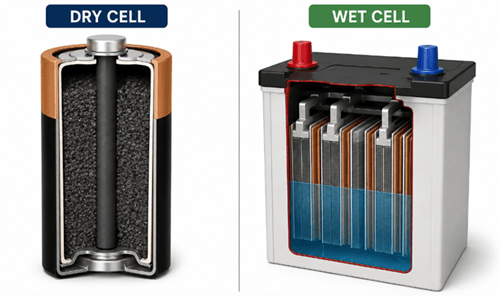
Zero Maintenance: Dry cells are fully sealed, meaning you never have to check fluid levels or periodically top them off with distilled water.
Higher Usable Capacity (Depth of Discharge): While wet cells usually require you to limit discharge to 50% to prevent damage, dry cell solar batteries (especially Lithium-ion) can be discharged to 90% to 100% without reducing their lifespan.
Installation Flexibility: Because there is no free-flowing liquid, dry cell batteries can be mounted in any orientation and are ideal for tight, indoor, or mobile spaces.
Enhanced Safety: They do not emit hazardous, explosive gasses under normal operation and pose zero risk of sulfuric acid spills or corrosion.
Longer Lifespan: Dry cell technologies, such as lithium, offer a much longer cycle life (often 3,000 to 5,000+ cycles) compared to the shorter lifespan of wet cells.
Superior Efficiency & Charging: Dry cells charge faster and generally waste less energy as heat during the charge and discharge process.
Types of Dry Cell Batteries
Dry cell batteries are portable, sealed devices that use an immobilized (paste or gel) electrolyte rather than a liquid, making them spill-proof. They are categorized into non-rechargeable (primary) and rechargeable (secondary) types.
Non-Rechargeable (Primary) Cells
Alkaline Batteries: The most common household battery. They use a zinc anode and manganese dioxide cathode, providing a stable 1.5 V output and a long shelf life of up to 10 years.
Zinc-Carbon Batteries: An older, traditional technology (also known as Leclanché cells). They use ammonium chloride or zinc chloride and are best for low-drain devices like remote controls and wall clocks.
Lithium (Primary) Batteries: Not to be confused with lithium-ion, these are single-use cells (e.g., CR2032 coin cells). They offer a high energy density, a very long lifespan, and exceptional performance in extreme temperatures.
Silver-Oxide Batteries: Typically found in small button-cell formats for watches and medical devices. They offer a stable voltage and high energy capacity for their size.
Rechargeable (Secondary) Cells
Lithium-Ion (Li-ion): The industry standard for portable electronics (smartphones, laptops, power tools). They are incredibly lightweight, have high energy density, and lack the “memory effect” found in older battery technologies.
Nickel-Metal Hydride (NiMH): The standard rechargeable alternative to AA and AAA alkaline batteries. They provide steady power and are favored for digital cameras and toys.
Nickel-Cadmium (NiCd): An older rechargeable technology heavily used in the past for power tools and toys. They hold a lot of power but suffer from memory effects and are being widely phased out in favor of NiMH and Li-ion.


Tony is a Aviation, Aerospace and Airplane Geek. He specializes in Aeronautics, Avionics, Military Air Assets, Airliners and Airlines