Sikorsky XV-2 Monocopter: The Aircraft that Broke the Physics Barrier With Its Single Blade
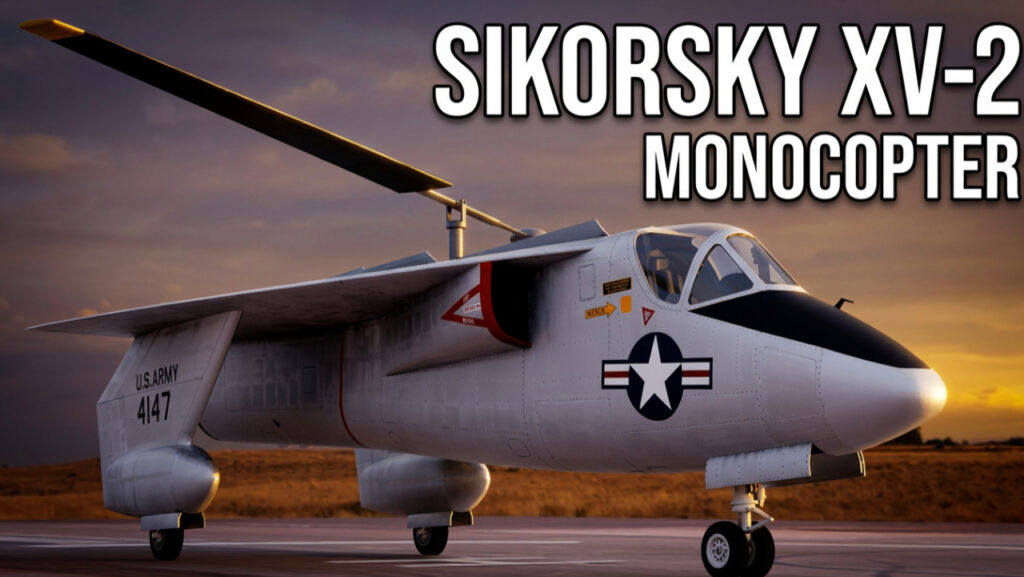
The Sikorsky XV-2 also known as the Sikorsky S-57 was one of the most radical and ambitious aviation experiments of the Cold War era. Proposed in the early 1950s, it was a “convertiplane”—a hybrid aircraft designed to take off vertically like a helicopter and then transform into a high-speed jet.
What made it legendary (and seemingly “physics-breaking”) was its single-blade rotor system. While it never reached the flight-testing stage, the engineering behind it remains a masterclass in solving the fundamental limitations of rotary-wing flight.
1. The Design: The “Single-Blade” Mystery
Most helicopters use 2, 3, or 4 blades to balance lift. A single-blade rotor sounds impossible because it is naturally unbalanced. However, the XV-2 utilized a monocopter rotor for a very specific reason: Retraction.
The Problem: In the 1950s, engineers wanted a jet that could hover. Multi-blade rotors are difficult to fold away into a fuselage because they are bulky.
Sikorsky proposed a single, massive rotor blade balanced by a heavy counterweight on the opposite side.
Once the XV-2 reached a high enough forward speed, the single rotor would stop spinning and be pulled back into a longitudinal slot in the top of the fuselage. This turned the aircraft into a clean-shaped jet with no drag-inducing rotor blades exposed.
2. Breaking the “Physics Barrier” (The Retreated Blade Stall):
The “physics barrier” the XV-2 aimed to break was the Retreating Blade Stall.
In a standard helicopter, as forward speed increases, the blade moving “backward” (retreating) relative to the flight path loses lift because its airspeed decreases. This limits conventional helicopters to a top speed of roughly 150–200 mph.
The XV-2 “broke” this barrier by changing the laws of the game:
1. Tip-Jet Propulsion: Instead of an engine turning a shaft (which produces massive torque), the XV-2 used a jet engine to blow compressed air out of the tip of the single rotor blade. This eliminated the need for a tail rotor and the heavy gearboxes that usually fail under high stress.
2. Eliminating the Rotor: By stopping and stowing the rotor entirely, the XV-2 bypassed the aerodynamic limits of rotary flight. It was designed to reach speeds of over 400 mph, which was double the speed of any helicopter at the time.
3. Engineering Challenges
While the design was brilliant on paper, it faced “physics” in the form of extreme mechanical stress:
Vibration: A single blade creates immense asymmetrical vibrations. Balancing a single 30-foot blade with a counterweight while it spins at high RPMs creates “centrifugal tension” that pushed 1950s metallurgy to its breaking point.
The Transition Gap: The most dangerous part of the flight was the “conversion.” As the rotor slowed down to be stowed, there was a period where the aircraft was neither a stable helicopter nor a stable fixed-wing jet. The risk of the aircraft tumbling or the blade snapping during the “stop-and-stow” process was extremely high.
4. Why was it Canceled?
The XV-2 was part of a competition for the U.S. Army and Air Force “Convertiplane” program.
The Competitor: It went up against the Bell XV-3, which used a “tiltrotor” design (the ancestor of today’s V-22 Osprey).
The Result: The military viewed the single-blade retraction system as too “high-risk” and technically complex. The XV-2 project was canceled in 1954 before a full-scale prototype could fly.
5. The Legacy of the Monocopter
The XV-2 remains a “Holy Grail” for aerodynamicists. It proved that asymmetry can work. With proper counterweights and tip-jets, a single blade is more efficient than two, as it doesn’t have to fly through the “dirty air” (vortices) of a leading blade.
Storable Rotors: The concept of “stop-fold-stow” is still being studied by DARPA today for high-speed Vertical Take-Off and Landing aircraft.
The Sikorsky XV-2 didn’t break physics by ignoring its laws, but by scheming a way to escape them. It remains one of the most daring examples of “outside the box” thinking in aviation history.
The Sikorsky XV-2 was an experimental single-blade helicopter developed in the 1950s. Although it never entered production, it demonstrated some interesting physics and working principles. Here’s a breakdown:
Main Components and Configuration:
The Sikorsky XV-2 had a single, long rotor blade and a small, counter-rotating tail rotor. The aircraft used a unique “co-axial” or “inter-meshing” rotor configuration, where two rotors rotated in opposite directions, but only one blade was used.
Physics and Working Principle:
The single-blade design relied on a few key principles:
1. Gyroscopic Effect: The single blade acted as a gyroscope, maintaining its plane of rotation due to its angular momentum. As the blade rotated, it created a gyroscopic force that helped stabilize the aircraft.
2. Counter-Torque: The small tail rotor provided a counter-torque to balance the torque created by the single blade. This allowed the aircraft to maintain directional control.
3. Rotor Dynamics: The single blade’s motion created a varying angle of attack along its length. As the blade rotated, the angle of attack changed, producing a varying lift distribution. This resulted in a periodic variation of lift and drag forces, which were managed by the aircraft’s control system.
4. Flapping and Feathering: The single blade was allowed to flap (move up and down) and feather (change its angle of attack) in response to changing conditions. This helped to maintain a stable and controlled flight.
The Control System:
The Sikorsky XV-2 monocopter’s control system was complex and innovative for its time. The pilot controlled the aircraft using:
1. Cyclic Stick: Controlled the blade’s angle of attack and tilt.
2. Collective Stick: Controlled the blade’s pitch angle and lift.
3. Tail Rotor Pedals: Controlled the direction of the aircraft.
Challenges and Limitations:
The single-blade design presented several challenges:
1. Vibration and Oscillation: The single blade created significant vibrations and oscillations, which made the aircraft uncomfortable for pilots and passengers.
2. Stability and Control: Maintaining stability and control was challenging, particularly during certain flight regimes.
3. Structural Integrity: The single blade had to withstand significant stresses, which added weight and complexity to the design.
The Sikorsky XV-2 Monocopter was an interesting experiment that pushed the boundaries of rotorcraft design. While it never entered production, it provided valuable insights into the physics and working principles behind single-blade aircraft. The lessons learned from this project have contributed to the development of more conventional multi-blade helicopters and other rotorcraft designs.


Tony is a Aviation, Aerospace and Airplane Geek. He specializes in Aeronautics, Avionics, Military Air Assets, Airliners and Airlines