Lagrangian Mechanics Explained in Aviation, Aeroelasticity and Aerodynamics

Lagrangian mechanics which formulates physics using energy (kinetic minus potential) rather than direct forces is foundational for modeling flight dynamics and tracking dispersed particles in aerodynamics. It enables engineers to derive exact equations of motion without tracking every internal constraint or reaction force.
Equations of Motion: For multi-body systems (e.g., an aircraft with moving control surfaces, flapping rotors, or flexible wings), Lagrangian equations easily synthesize the complex interplay of gravity, aerodynamics, and inertial forces.
State-Space Modeling: It translates directly into the generalized coordinates (position, roll, pitch, yaw) used to build stability matrices and autopilot algorithms.
Aeroelasticity: It is heavily used to model structural deformation. By summing the energy of a vibrating wing, aerospace engineers accurately predict flutter and structural loads.
Aircraft Icing: Predicting where supercooled water droplets strike a wing and freeze is done by tracking individual droplet trajectories through the airflow.
Emissions and Wakes: It is used to simulate the dispersion of engine exhaust, contrails, or atmospheric turbulence behind an aircraft.
Orbital Mechanics: Lagrangian mechanics is essential for calculating orbital transfers and maneuvering spacecraft using specific reference frames.
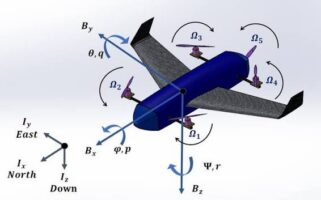
UAV and Drone Design: For modern multirotors and tilt-rotors, the Euler-Lagrange Framework is used to derive accurate nonlinear dynamic models, ensuring stable flight control and precise maneuvering.
Lagrangian mechanics is a powerful tool for analyzing complex systems in aviation and aerodynamics. However, its application in these fields is not without challenges. Here are some critical issues to consider:
1. Nonlinearity and Chaos: Many problems in aviation and aerodynamics involve nonlinear dynamics, which can lead to chaotic behavior. Lagrangian mechanics can struggle to capture these effects accurately, especially when dealing with complex systems like turbulent flows or nonlinear structural dynamics.
2. Non-conservative Systems: Lagrangian mechanics is well-suited for conservative systems, but many problems in aviation and aerodynamics involve non-conservative forces like friction, drag, and thrust. These forces can be difficult to model accurately within the Lagrangian framework.
3. Coordinate Selection: The choice of coordinates can significantly impact the complexity and accuracy of Lagrangian mechanics. In aviation and aerodynamics, the selection of coordinates can be critical, especially when dealing with complex systems like aircraft with multiple control surfaces or rotating components.
4. Singularities and Numerical Instabilities: Lagrangian mechanics can sometimes lead to singularities or numerical instabilities, particularly when dealing with systems that have multiple degrees of freedom. These issues can arise when the Lagrangian is not properly formulated or when the numerical methods used to solve the equations of motion are not suitable.
5. Aerodynamic Modeling: In aerodynamics, the modeling of aerodynamic forces and moments can be a significant challenge. Lagrangian mechanics relies on a accurate representation of these forces, which can be difficult to obtain, especially for complex aircraft configurations or when dealing with unsteady flows.
6. Multi-Body Dynamics: In some aviation and aerodynamics problems, multiple bodies are involved, such as aircraft with multiple wings or rotorcraft. Lagrangian mechanics can be used to model these systems, but the formulation can become complex, and the computational cost can be high.
7. Uncertainty and Sensitivity: Lagrangian mechanics assumes a high degree of accuracy in the modeling of the system. However, in aviation and aerodynamics, there are often uncertainties in the modeling of aerodynamic forces, structural properties, or other parameters. These uncertainties can propagate through the Lagrangian formulation and impact the accuracy of the results.
8. Validation and Verification: The application of Lagrangian mechanics in aviation and aerodynamics requires validation and verification against experimental or computational fluid dynamics (CFD) data. However, this can be challenging, especially for complex systems or when dealing with limited experimental data.
Some potential solutions to these challenges include:
Using alternative formulations, such as Hamiltonian mechanics or Newtonian mechanics, which can be more suitable for certain problems.
Developing advanced numerical methods, such as symplectic integration or structure-preserving methods, which can improve the accuracy and stability of the simulations.
Incorporating uncertainty quantification and sensitivity analysis to account for uncertainties in the modeling of the system.
Using CFD or other high-fidelity tools to validate and verify the results of Lagrangian mechanics.
Overall, Lagrangian mechanics remains a powerful tool for analyzing complex systems in aviation and aerodynamics. However, its application requires careful consideration of the challenges and limitations mentioned above.
2D Pendulum Simulation using Lagrangian Mechanics
This code demonstrates a simple application of Lagrangian mechanics to a 2D pendulum. The pendulum is modeled as a point mass attached to a massless rod of length `L`. The Lagrangian is used to derive the equations of motion, which are then solved numerically using the `scipy.integrate.odeint` function.
### Code
“`python
import numpy as np
from scipy.integrate import odeint
import matplotlib.pyplot as plt
# Constants
g = 9.81 # acceleration due to gravity (m/s^2)
L = 1.0 # length of pendulum (m)
# Initial conditions
theta0 = np.pi/3 # initial angle (rad)
omega0 = 0.0 # initial angular velocity (rad/s)
# Time points
t = np.linspace(0, 10, 500)
# Lagrangian and equations of motion
def equations_of_motion(y, t, g, L):
theta, omega = y
dydt = [omega, -g/L * np.sin(theta)]
return dydt
# Solve ODE
y0 = [theta0, omega0]
sol = odeint(equations_of_motion, y0, t, args=(g, L))
# Plot results
plt.figure(figsize=(10, 5))
plt.subplot(121)
plt.plot(t, sol[:, 0], label=’θ(t)’)
plt.plot(t, sol[:, 1], label=’ω(t)’)
plt.xlabel(‘t [s]’)
plt.ylabel(‘angle [rad] and angular velocity [rad/s]’)
plt.legend()
plt.subplot(122)
plt.plot(sol[:, 0], sol[:, 1])
plt.xlabel(‘θ [rad]’)
plt.ylabel(‘ω [rad/s]’)
plt.title(‘Phase space’)
plt.tight_layout()
plt.show()
“`
### Explanation
1. We define the constants `g` and `L`, and the initial conditions `theta0` and `omega0`.
2. We define the time points `t` at which we want to solve the equations of motion.
3. We define the Lagrangian and derive the equations of motion using the Euler-Lagrange equation. In this case, the Lagrangian is `L = T – U = 1/2 * m * L^2 * omega^2 – m * g * L * (1 – cos(theta))`, and the equations of motion are `dtheta/dt = omega` and `domega/dt = -g/L * sin(theta)`.
4. We solve the ODE using `scipy.integrate.odeint`.
5. We plot the results, including the angle and angular velocity as functions of time, and the phase space trajectory.
### Running the code
Save this code to a file (e.g., `pendulum.py`) and run it using `python pendulum.py`. This will generate a plot of the pendulum’s motion.
This code models a simple 2D pendulum using Lagrangian mechanics and solves the equations of motion using `scipy.integrate.odeint`. The resulting plot shows the time history of the pendulum’s angle. Note that this is a highly simplified example and real-world applications of Lagrangian mechanics in aviation and aerodynamics would require more complex formulations and numerical methods.
Important Notes on Lagrangian Mechanics
Lagrangian mechanics is a way to understand how things move. It is actually different from the way we usually think about the most popular form of movement or motion, which is called Newtonian mechanics. Both Lagrangian mechanics and Newton mechanics when thinking of motion can be used to explain the same things, but Lagrangian mechanics has some special features that make it really useful for certain types of problems.
The Lagrangian
The first thing you need to know about Lagrangian mechanics is the idea of the Lagrangian. This is a special kind of math formula that tells you how much energy is in a moving object.
Definition and the Concept of Energy
Energy is the ability to do work, e.g, like lifting a heavy object or making something move.
The Lagrangian is based on the kinetic energy, which is the energy of motion, and the potential energy, which is the energy stored in an object because of its position.
To understand the Lagrangian, let’s think about a ball on a hill. If the ball is at the top of the hill, it has a lot of potential energy because it could roll down and do a lot of work. But if the ball is at the bottom of the hill, it doesn’t have as much potential energy but it has kinetic energy, which is the energy it has from moving. If the ball is rolling down the hill, it has a lot of kinetic energy. But if it’s just sitting still at the bottom, it doesn’t have any kinetic energy.
This just simply means that the ball has both kinetic energy, due to its motion, and potential energy, due to its height relative to the bottom of the hill and the Lagrangian describes the total energy of the ball as it rolls down the hill, including both its kinetic and potential energy.
Combining Kinetic and Potential Energy
The Lagrangian tells us how much energy is in the ball at any point in time, by combining the kinetic and potential energy. To find the Lagrangian, you need to choose a set of coordinates, which are like a map that tells you where the ball is at any point in time. Once you know the coordinates, you can plug them into the Lagrangian formula and find out how much energy is in the ball.
Using the Lagrangian
Once you have the Lagrangian, you can use something called Lagrange’s equations to figure out how the ball will move. These equations are a bit like Newton’s second law, which says that force equals mass times acceleration. But instead of force, Lagrange’s equations use the Lagrangian, and instead of acceleration, they use something called the generalized coordinates. These are a way of describing the position of the ball at any point in time.
By using the Lagrangian and the generalized coordinates, you can figure out how the ball will move, without having to worry about all the forces acting on it.
Applications of Lagrangian Mechanics
Lagrangian mechanics is used in many different areas of science and engineering. In mechanics, it is used to study the motion of objects like pendulums, or double pendulums. In field theory, it is used to understand the behavior of things like electromagnetic fields and gravity. And in quantum mechanics, it is used to explain wave-particle duality and the Schrödinger equation.
One of the biggest advantages of Lagrangian mechanics is that it can help simplify the equations of motion. Instead of having to think about all the different forces acting on an object, you can just focus on the Lagrangian and the generalized coordinates. This can make it a lot easier to solve problems and understand how things move.
Another advantage of Lagrangian mechanics is that it can help us understand how energy is conserved. This means that energy can’t be created or destroyed, it can only be transferred from one place to another. When you use the Lagrangian to study a problem, you can see how the energy changes and how it is conserved.
Finally, Lagrangian mechanics is primarily used to study conservative systems, where energy is conserved.
However, it can also be extended to study non-conservative systems through advanced formulations such as non-conservative Lagrangian mechanics.


Tony is a Aviation, Aerospace and Airplane Geek. He specializes in Aeronautics, Avionics, Military Air Assets, Airliners and Airlines