How Boeing Outsmarted Airbus and Built the 777X that Made A380 Obsolete
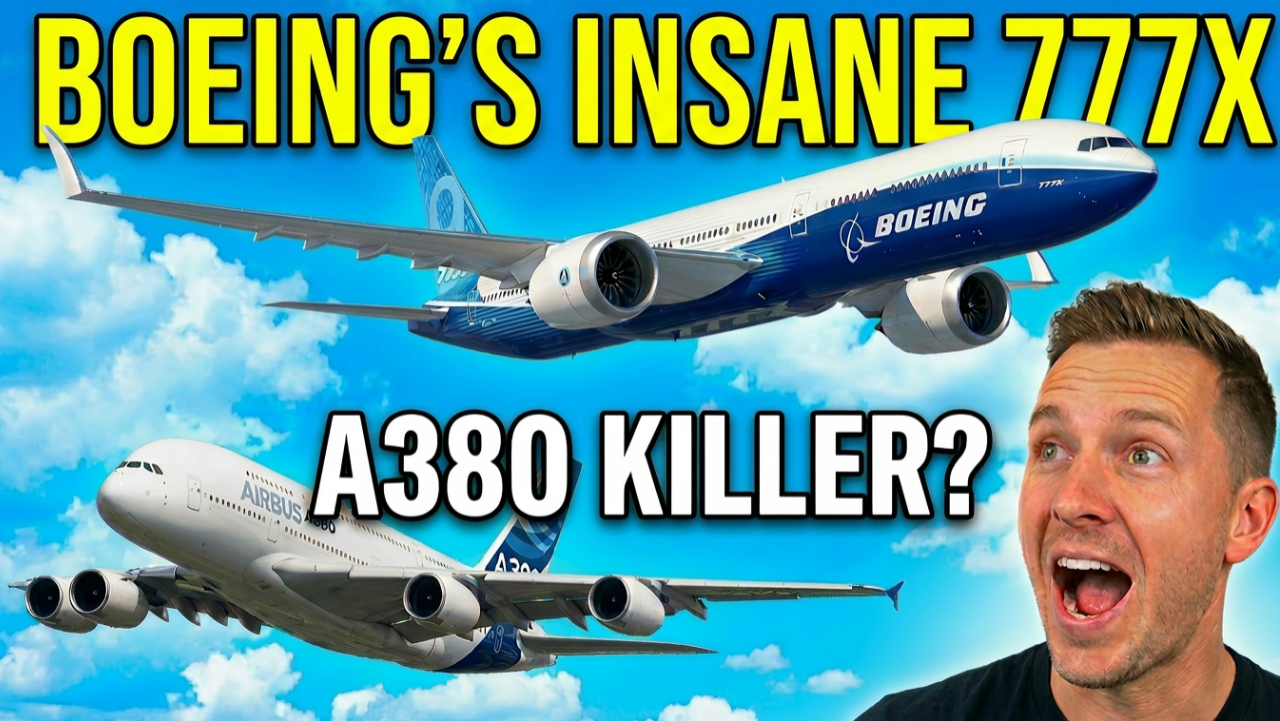
Boeing outsmarted Airbus not by building a competing quadjet, but by utilizing a massive, highly efficient twin-engine aircraft to capture the A380’s passenger capacity while avoiding its costly infrastructure restrictions. By betting on twin-engine economics, Boeing made the A380 commercially obsolete.
Boeing achieved this market shift through several key strategies
1. Airport Compatibility and Folding Wingtips: The A380 requires massive, expensive airport modifications (such as special double-deck jet bridges and wider taxiways). Boeing cleverly engineered the 777X with folding wingtips. In flight, they extend to 235 feet for maximum aerodynamic efficiency, but on the ground, they fold up, allowing the plane to fit into standard gates without requiring airports to remodel.
2. Unmatched Twin-Engine Efficiency: The 777-9 carries over 400 passengers but operates with only two engines, drastically reducing maintenance and fuel burn compared to the four-engine A380. This allows airlines like Emirates to serve dense trunk routes with superior profit margins.
3. Ultra-Long-Range Capability: By using cutting-edge carbon-fiber composite wings and massive, fuel-efficient GE9X engines, the 777X family (including the ultra-long-haul 777-8) offers more route flexibility than the heavier A380.
Because of these innovations, Boeing secured massive orders from core A380 customers—most notably Emirates—who realized the 777X provided comparable capacity with vastly superior operating economics and route flexibility.
The Boeing 777X’s GE9X engines are substantially more efficient than the Airbus A380’s four engines. The GE9X is a modern twin-engine setup built for maximum bypass and fuel savings, yielding roughly 13% lower fuel consumption per seat compared to the older, four-engine A380.
Key Efficiency Differences
1. Engine Configuration: The GE9X uses a massive 134-inch front fan and an ultra-high bypass ratio, allowing it to produce up to 110,000 pounds of thrust while burning drastically less fuel.
The A380 relies on four separate engines, which naturally produce more drag and incur higher maintenance costs.
2. Aircraft Weight: The GE9X powers a significantly lighter, carbon-composite aircraft with a Maximum Takeoff Weight of around 351 to 365 tons. The A380, designed for maximum capacity, weighs up to 575 tons, requiring more thrust and fuel just to keep the heavy frame aloft.
3. Maintenance & Economics: By having only two engines instead of four, the 777X requires 50% fewer powerplants to maintain, driving down long-term operating costs.
Airbus’s direct response to Boeing’s 777X is the Airbus A350 family, specifically the A350-1000. Rather than building a direct, clean-sheet physical competitor to the massive 777X, Airbus positioned the A350-1000 as a lighter, highly efficient, and modern composite alternative capable of handling long-haul and ultra-long-haul routes.
Airbus’s strategy and specific counter-offer break down as follows:
1. The Direct Rival: The Airbus A350-1000 competes directly with the smaller 777X variant which is the 777-8 and serves as a capable alternative to the larger 777-9.
2. Fuel Efficiency: The A350 relies heavily on advanced materials—about 53% carbon-fiber composites. This makes it lighter and inherently more fuel-efficient than Boeing’s heavier metal and composite-hybrid frame.
3. Ultra-Long-Range Dominance: Airbus leveraged the A350 family to capture the ultra-long-haul market, including specialized variants like the A350-1000 ULR (Ultra Long Range) utilized for nonstop routes.
Physical Differences and Philosophy
Airbus intentionally opted for a narrower cabin cross-section compared to the 777X. The 777X features a wider cabin meant for a denser 10-abreast seating layout. In contrast, Airbus opted for an 18.4-foot internal width, optimized mostly for 9-abreast seating which provides excellent passenger comfort while keeping the aircraft weight down. Unlike the Boeing 777X, which requires complex and heavy folding wingtips to fit into standard airport gates, the A350 uses a fixed-span aerodynamic wing design, keeping maintenance operations simpler.
More importantly, While the A350 battles the 777X for top-tier capacity and premium long-haul routes, Airbus also answered the broader widebody market with the A330neo.
Instead of spending billions to reinvent a massive flagship like Boeing did with the 777X, Airbus took a low-risk approach. They upgraded their existing A330 frame with highly efficient Rolls-Royce engines and aerodynamic “sharklets”. This gave airlines a cheaper, familiar, and highly reliable profit machine.