The Next-Gen USS Gerald R. Ford Aircraft Carrier Explained
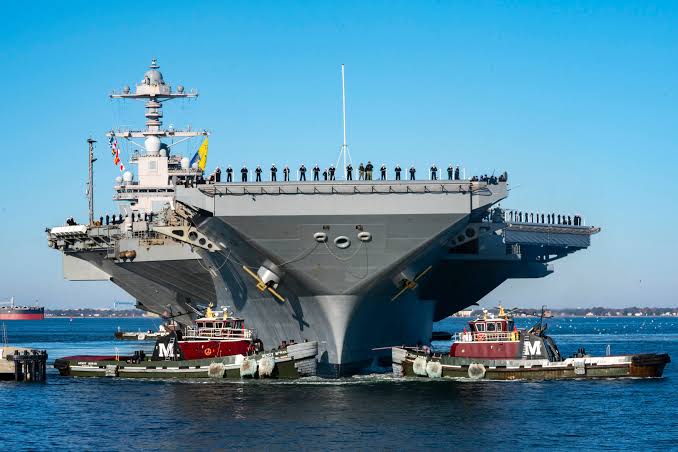
The USS Gerald R. Ford (CVN-78) is the lead ship of the Gerald R. Ford-class aircraft carriers, the newest and most advanced class of aircraft carriers in the United States Navy. Here is a detailed description of this impressive vessel:
Design and Construction
The USS Gerald R. Ford was designed by Northrop Grumman Shipbuilding (now Huntington Ingalls Industries) and built at the company’s Newport News Shipbuilding facility in Virginia. The ship was laid down on February 11, 2006, and launched on October 11, 2013. The USS Gerald R. Ford was commissioned on July 22, 2017.
Key Features
1. Hull Design: The Gerald R. Ford-class carriers feature a new hull design, which includes a larger flight deck, a redesigned island, and a more efficient propulsion system.
2. Size and Displacement: The USS Gerald R. Ford is approximately 1,092 feet long, 257 feet wide, and has a draft of 32 feet. The ship displaces around 100,000 tons of water.
3. Propulsion: The ship is powered by two A4W nuclear reactors, which provide steam for four main turbine generators. These generators produce electricity for the ship’s propulsion and systems.
Aircraft and Aviation Features
1. Flight Deck: The USS Gerald R. Ford has a larger flight deck than previous carriers, with more space for aircraft parking, fueling, and maintenance.
2. Catapults: The ship features two Electromagnetic Aircraft Launch Systems (EMALS), which replace traditional steam catapults. EMALS provide more efficient and smoother launches.
3. Arresting Gear: The ship is equipped with an Advanced Arresting Gear (AAG) system, which uses a combination of engines and generators to slow down landing aircraft.
Defensive Systems
1. Radar and Sensors: The USS Gerald R. Ford features advanced radar and sensor systems, including the Dual Band Radar (DBR) and the Advanced Electronic Attack (AEA) system.
2. Missile Defense: The ship is equipped with the Rolling Airframe Missile (RAM) system and the Evolved Sea Sparrow Missile (ESSM) system.
Crew and Accommodations
1. Crew: The USS Gerald R. Ford has a crew of approximately 5,000 personnel, including sailors, officers, and airmen.
2. Accommodations: The ship features modern living quarters, including spacious berthing areas, a gym, and a medical facility.
Technology and Innovation
1. Advanced Computing: The USS Gerald R. Ford features advanced computing systems, including a ship-wide network and a data center.
2. Electric Propulsion: The ship’s electric propulsion system provides increased efficiency and reduced noise.
Its Specifications
It has a Length of 333 meters, a Beam of 78 meters, a daft of 9.7 meters and a Displacement of 100,000 tons.
Its Speed is Over 30 knots which is 56 kilometers per hour and a Crew of 5,000 personnel.
It is used to launch several fighter jets and other aircraft such as the F/A-18, the F-35C, the E-2C, the C-2A, the MH-60S and the MH-60R.
The USS Gerald R. Ford represents a significant leap forward in aircraft carrier design and technology, providing the US Navy with a highly capable and flexible platform for maritime operations.
While there are several Russian and Chinese aircraft carriers under development or in service, none of them currently match the USS Gerald R. Ford in terms of advanced technology. However, here are some notable examples:
Russian Aircraft Carriers
1. Admiral Gorshkov (Admiral Gorshkov-class): Russia’s first new aircraft carrier, launched in 2010, but still undergoing sea trials. It features a ski-jump ramp and can carry 28 aircraft.
2. Admiral Kuznetsov (Navy’s only operational aircraft carrier): Launched in 1985, it’s currently undergoing repairs and modernization. It has a ski-jump ramp and can carry 33 aircraft.
Chinese Aircraft Carriers
1. Liaoning (Type 001): China’s first aircraft carrier, commissioned in 2012. It’s a refurbished Soviet-era carrier with a ski-jump ramp and can carry 24-30 aircraft.
2. Shandong (Type 001A): China’s second aircraft carrier, launched in 2017. It’s an improved version of the Liaoning, with a similar design and capabilities.
3. Type 002 (Cavitation): China’s third aircraft carrier, launched in 2019. It’s a more advanced design with a flat flight deck and electromagnetic catapults (EMALS), similar to the USS Gerald R. Ford.
Comparison with USS Gerald R. Ford
While the Chinese and Russian aircraft carriers have made significant progress, they still lag behind the USS Gerald R. Ford in several areas:
1. Electromagnetic Catapults (EMALS): The USS Gerald R. Ford features EMALS, which allow for more efficient and safer aircraft launches. Only the Chinese Type 002 has similar technology, but it’s still in development.
2. Advanced Arresting Gear (AAG): The USS Gerald R. Ford has an AAG system, which provides a safer and more efficient way to recover aircraft. The Chinese and Russian carriers use traditional arresting gear or have not disclosed their systems.
3. Stealth Technology: The USS Gerald R. Ford incorporates stealth design elements to reduce its radar cross-section. The Chinese and Russian carriers do not have similar features.
4. Integrated Power System (IPS): The USS Gerald R. Ford has an IPS, which provides more efficient power distribution and increased survivability. The Chinese and Russian carriers have traditional propulsion systems.
In summary, while the Russian and Chinese aircraft carriers have made significant progress, they still trail behind the USS Gerald R. Ford in terms of advanced technology. However, the gap is narrowing, and future developments will likely see more capable and advanced aircraft carriers from these nations.
The United States Navy has plans to build a successor to the Gerald R. Ford-class aircraft carriers, but a formal program has not been officially announced. However, there are ongoing efforts to develop a next-generation aircraft carrier, known as the:
Next-Generation Aircraft Carrier (NGAC) or CV(X) program:
The CV(X) program aims to develop a new class of aircraft carriers that will replace the existing Nimitz-class and Gerald R. Ford-class carriers. The program is still in its early stages, with the Navy conducting studies and analysis to define the requirements and capabilities of the future carrier.
Key Goals and Features of the CV(X) Program
1. Advanced technology: Integration of emerging technologies, such as artificial intelligence, unmanned systems, and advanced sensors.
2. Increased survivability: Improved ship design and materials to enhance survivability and reduce vulnerability to threats.
3. Enhanced power generation**: More efficient and powerful propulsion systems to support future aircraft and systems.
4. Modular design: A modular design approach to facilitate easier upgrades and integration of new technologies.
5. Reduced life-cycle costs: A focus on reducing life-cycle costs through efficient design, materials, and maintenance.
The Navy plans to begin construction of the first CV(X) ship in the late 2020s, with a projected service date in the 2030s. However, this timeline is subject to change based on various factors, including budget, technological advancements, and shifting naval priorities.
Potential Design Concepts
Several design concepts have been proposed or are being explored, including:
1. Nuclear-powered: A nuclear-powered design, similar to the Gerald R. Ford-class, to provide long-endurance and high-power capabilities.
2. Conventional propulsion: A conventional propulsion system, such as a gas turbine or diesel-electric, to reduce costs and complexity.
3. Unmanned and autonomous: Integration of unmanned and autonomous systems to enhance ship capabilities and reduce crew requirements.
While the CV(X) program is still in its early stages, it is clear that the US Navy is planning to develop a next-generation aircraft carrier that will replace its existing fleet and provide advanced capabilities for future naval operations.