10 Weaponized Drones With Proven Military Battlefield Operations

Weaponized drones range from large, military-grade Unmanned Combat Aerial Vehicles (UCAVs) to small, commercial quadcopters modified to drop explosives. Over the last few years, the landscape of drone warfare has rapidly expanded, introducing sophisticated suicide drones and small-arms aircraft.
These weaponized systems are categorized into distinct classes based on their design and battlefield application:
High-Altitude Military UCAVs
These are traditional, large military drones built to carry heavy payloads. They operate similarly to conventional fighter jets but are piloted remotely via satellite links.
MQ-9 Reaper (USA): Considered the global benchmark for high-altitude combat drones. The MQ-9 Reaper is typically armed with up to four laser-guided Hellfire missiles and GBU-12 Paveway II laser-guided bombs. It can fly continuously for up to 27 hours.
Bayraktar TB2 (Turkey): This is a medium-altitude, long-endurance UCAV. It is armed with laser-guided smart munitions and became globally prominent for its heavy use in localized conflict zones and the Ukraine war.
AAIRQ-7 Shadow (USA): While primarily a surveillance drone, modern variants of these drones have been tested and equipped with micro-guided munitions to strike high-value targets dynamically.
Kamikaze and Loitering Munitions
Commonly called “suicide drones,” these aircraft are the missile itself. They are built to circle over a combat area, identify targets, and deliberately crash into them to detonate an onboard warhead.
Shahed-136 and Geran-2 (Iran/Russia): A delta-wing loitering munition. It uses an internal GPS guidance system to hit stationary infrastructure hundreds of miles away. It travels slowly but is deployed in mass swarms to overwhelm modern air defense grids.
Switchblade 300/600 (USA): These are backpack-portable loitering munitions launched from a tube. The smaller 300 variant targets infantry personnel, while the larger 600 variant is engineered to pierce heavy armor and main battle tanks.
Arash Drone (Iran): This is a long-range kamikaze drone recently noted for targeting regional infrastructure and military sites with heavy payload capacities.Weaponized Small Arms & Gun Drones
Engineering advancements have successfully integrated recoil-compensation systems, allowing standard multi-rotor drones to accurately fire firearms in mid-air.
TIKAD Drone (Duke Robotics): They were Developed by a US firm. This stable octocopter is outfitted with a proprietary robotic gimbal capable of mounting and firing a machine gun or a grenade launcher. It isolates recoil to maintain steady flight.
AR-1 Assault Rotor (DronesVision): A specialized quadcopter built to carry and discharge an onboard 5.56mm assault rifle or a 9mm submachine gun, managed through an integrated targeting camera.
Modified Commercial and FPV Drones
Improvised explosive devices (IEDs) have shifted to the air through consumer electronics. Militaries and non-state groups frequently adapt standard store-bought quadcopters for offensive use.
FPV Kamikaze Drones: These drones are Consumer First-Person View (FPV) racing drones which are sometimes adapted to carry tactical warheads. Operators pilot them into armored vehicles or infantry positions using real-time video feeds.
Commercial Payload Droppers: These are Standard multi-rotor consumer drones are retrofitted with specialized release mechanisms.
These allow pilots to hover over targets and release unguided munitions, such as mortar rounds or fragmentation grenades, with significant precision.
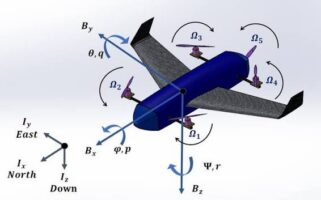
A drone (or UAV) is a complex system of hardware and electronics working in harmony. Here are the major components and how they function together to achieve flight:
1. The Core Structure
Frame: This is the “skeleton” of the drone. It houses all the components and provides the structural integrity needed to withstand the stress of flight and landings.
Arms: These extend from the frame and hold the motors in place. Their length and positioning determine the drone’s stability and maneuverability.
2. The Propulsion System
Motors: Most modern drones use Brushless DC motors. They provide the high-speed rotation necessary to generate thrust. Each motor’s speed is controlled independently to allow the drone to move in different directions.
Propellers: These are the “wings” of the drone. By spinning rapidly, they create a pressure difference that generates lift. In a quadcopter, two propellers spin clockwise and two spin counter-clockwise to cancel out torque, allowing the drone to stay stable.
Electronic Speed Controllers (ESCs): These act as the intermediate between the flight controller and the motors. The ESCs take the signal from the “brain” and deliver the exact amount of power from the battery to each motor to adjust its speed.
3. The “Brain” and Intelligence
Flight Controller (FC): This is the drone’s processor. it collects data from various sensors and sends commands to the ESCs. It makes micro-adjustments hundreds of times per second to keep the drone level and responsive to pilot inputs.
Inertial Measurement Unit (IMU): Consists of gyroscopes (to measure tilt) and accelerometers (to measure movement). This data allows the Flight Controller to understand the drone’s orientation in space.
GPS Module: Provides latitude, longitude, and altitude data. This allows for features like “Position Hold,” “Waypoints,” and “Return to Home.”
4. Power and Communication
Battery: Usually Lithium Polymer (LiPo) batteries because they offer high power output and are relatively lightweight. The battery provides energy to the motors and all onboard electronics.
Receiver (RX): This antenna receives radio signals from the pilot’s remote control and passes those commands to the Flight Controller.
Transmitter (TX): The handheld remote used by the pilot to send steering and throttle commands.
5. Specialized Components (Payload)
Camera and Gimbal: While the camera captures footage, the Gimbal is a motorized support system that uses sensors to keep the camera perfectly level, even if the drone is tilting or vibrating during flight.
Video Transmitter (VTX): In FPV (First Person View) drones, this sends a live video signal from the drone’s camera back to the pilot’s goggles or a screen.
How They Work Together
When you push the joystick forward, the Flight Controller calculates that the rear motors need to spin faster than the front motors. It sends this command to the ESCs, which pump more power into the rear Motors.
The rear Propellers create more lift, tilting the drone forward and causing it to move in that direction.
Throughout this process, the IMU and GPS are constantly feeding data back to the “brain” to ensure the drone doesn’t flip over or drift off course.
GPS guided drones and FPV (First Person View) drones differ primarily in flight control, stability, and purpose.
GPS drones offer automated stabilization, auto-hover, and return-to-home safety features, whereas FPV drones rely on raw, manual acrobatics through video goggles.
Flight Control and Stability
GPS Drones: These drones use satellite signals to hold position, hover in place, and fly preset paths automatically. Letting go of the sticks makes them stop and stay still.
FPV Drones: These drones require constant pilot input with no auto-hover or self-leveling in manual mode. Letting go means the drone keeps moving on its current path or crashes.
Camera and Video Output of Drones
GPS Drones feature stabilized gimbals shooting smooth 4K or 8K video designed for cinematic photography.
FPV Drones have a mounted fixed-tilt camera connected to video goggles for real-time, low-latency flight views used in racing and fast stunts.
Safety and Ease of Use
GPS Drones are very beginner-friendly with built-in return-to-home safety if signal or battery is low.
FPV Drones require a high learning curve and extensive practice, with a higher risk of crashes during manual flight.
AI-powered autonomy, swarm intelligence, and advanced multispectral sensing are the leading drone technologies revolutionizing industries.
The integration of edge AI allows drones to navigate complex environments, dodge obstacles, and execute missions without human intervention.
In Edge AI, processing data directly on the drone is achieved. Real-time flight planning and obstacle avoidance without a continuous human input required.
Computer Advanced 3D spatial mapping where Machine learning models independently identify targets, structures, or anomalies.


Tony is a Aviation, Aerospace and Airplane Geek. He specializes in Aeronautics, Avionics, Military Air Assets, Airliners and Airlines